By Swati Pandey
SYDNEY (Reuters) – A viral epidemic emanating from China could shave 0.2 percentage points off Australia’s economic growth in the current quarter with its spillover effects seen larger than the 2003 SARS outbreak, the country’s top central banker said on Friday.
The Reserve Bank of Australia (RBA) has also ramped up focus on its business liaison program to get a better handle on the impact on the A$2 trillion ($1.3 trillion) economy, with tourism and education sectors seen the worst hit.
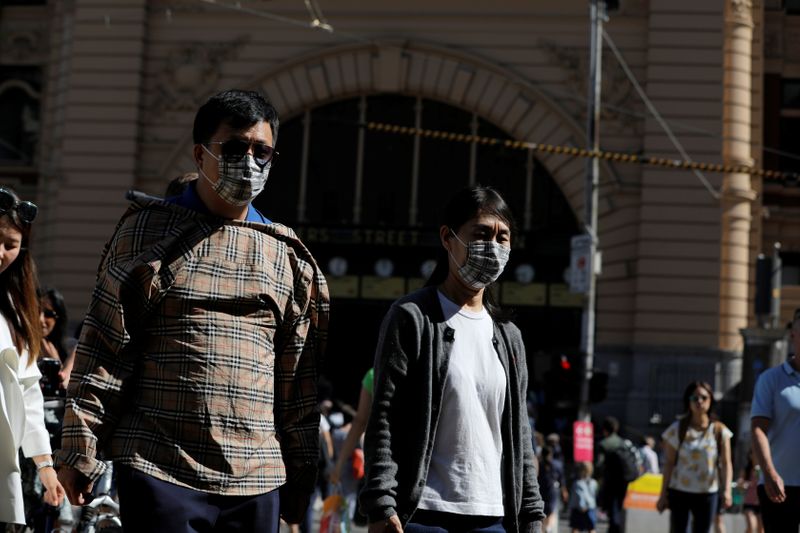
Coronavirus, believed to have originated in the central Chinese city of Wuhan, has so far killed almost 640 people in the mainland and forced the country into a complete lockdown.
The outbreak is inflicting a growing toll on businesses and consumers in the world’s second-largest economy, prompting China’s central bank to step up policy support including lower interest rates.
“It is still too early to tell but the impact is going to be large,” RBA Governor Philip Lowe told a parliamentary economics panel in Canberra.
When asked if the hit to Australia’s economy would be worse than SARS, Lowe said, “Given what we know at the moment, I think that is true.”
If the virus “persists for an extended period, the effect on economic activity is likely to be larger than currently projected,” he added.
Australia’s economy is already in the slow lane despite three rate cuts last year to a record low 0.75% with weak consumption weighing on inflation.
As tourist numbers slide and consumer spending slows, analysts at Australia & New Zealand Banking Group (AX:) see the economy shrinking in the March quarter, the first contraction since 2011.
Fitch Ratings expects retail-exposed real estate trusts such as Scentre Group (AX:) and Mirvac (AX:) to take some hit as would airline Virgin Australia (AX:) and casino operator Crown Resorts (AX:).
“If the impact from the virus is short-lived, we do not expect credit profiles to be materially affected. However, if the outbreak is not sufficiently contained by 1Q20, more corporate issuers can face rating pressures,” Fitch said.
In a separate statement ratings agency Moody’s said Australian universities face the “greatest immediate credit risk” due to their high concentration of Chinese students, their proximity to affected regions, and the fact that the outbreak coincides with the start of their academic year.
Fusion Media or anyone involved with Fusion Media will not accept any liability for loss or damage as a result of reliance on the information including data, quotes, charts and buy/sell signals contained within this website. Please be fully informed regarding the risks and costs associated with trading the financial markets, it is one of the riskiest investment forms possible.