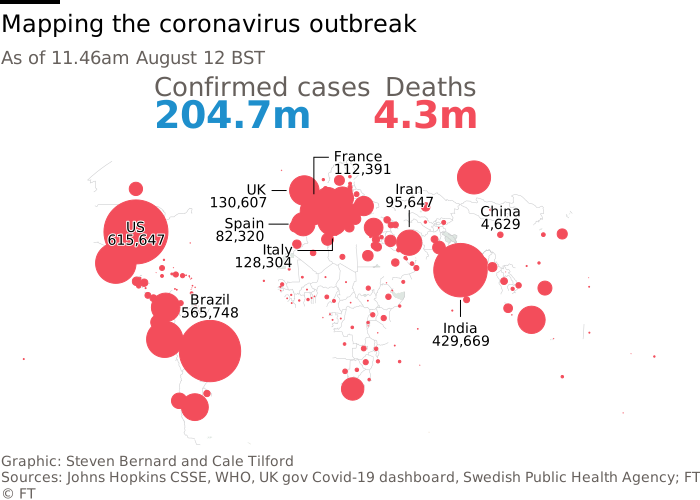
The coronavirus outbreak is hitting China’s exports and disrupting global supply chains. The world’s second-largest economy has been at a near standstill for two weeks after the government extended the lunar new year holiday to contain the disease, which has killed more than 1,000 people and infected 40,000 worldwide.
Though employees are trickling back to work, many companies have delayed restarting production in China and elsewhere. Consumers are avoiding shops and restaurants, and transports links remain disrupted.
“The spread of the virus — or more accurately, the effort to contain it — poses the biggest near-term threat to global growth,” says Neil Shearing, chief economist at Capital Economics.

Global growth will take a hit
The impact is expected to be much greater than the outbreak of Sars, another coronavirus that originated in China in 2002. The Chinese economy is now more than four times larger and more interconnected with the rest of the world.
Deutsche Bank forecasts that, due to the current coronavirus, Chinese growth will be 1.5 per cent lower in the first quarter of 2020 compared to the same period in 2019, at 4.6 per cent. Global growth is expected to be 0.5 percentage points slower.

Economics consultancy Oxford Economics expects an even stronger impact on China’s growth and has downgraded its outlook for global growth to 2.3 per cent for 2020, down from 2.5 per cent — a rate that would mark the weakest annual expansion since 2009.
The scale of the disruption is already visible in a double-digit drop in passenger volume in China over the lunar new year as a result of efforts to contain the disease, according to official statistics. Major centres, including the city of Wuhan — the epicentre of the crisis, have been largely shut down.


Companies around the world are running out of components
China is the world’s largest exporter of electrical and electronic components, five times the value of Germany, and accounts for 30 per cent of exports globally, according to data from Unctad, the United Nations Conference on Trade and Development.
“The coronavirus outbreak is likely to keep the global manufacturing sector in recession in first half of 2020. Electronics and computers are most at risk,” said Ana Boata, economist at Allianz Research.

Wuhan has emerged as a hub for China’s booming cars parts and accessories exports, a sector that has tripled in the last decade while engine and motor exports have risen four times. Many of these factories have been closed.
The dearth of components is being felt abroad. Italian-American manufacturer Fiat Chrysler has warned it is struggling to source key parts from Chinese suppliers, and could be forced to halt production in a matter of weeks. Carmaker Hyundai was forced to close its South Korean factories in the first week of February, while Volkswagen has postponed restarting production at its China plants until February 17.
Asian emerging economies are particularly exposed to the stoppages. More than one-third of imports of manufactured goods into South Korea, Vietnam, Indonesia and the Philippines come from China.
“China’s role at the centre of global supply chains increases the likelihood that the disruption spreads to other countries,” said Mr Shearing. “Economies in Emerging Asia look most vulnerable, as do firms operating in both the tech and electronics sectors.”


Consumer demand is down
Chinese demand is set to weaken as shoppers stay at home and services remain closed. This has global repercussions as the country accounts for 11 per cent of the world’s imports of goods, up from 2.7 per cent 20 years ago.
Big brand retailers — such as Levi Strauss, Ikea, H&M, Nike and Starbucks — have closed many of their stores in China. The Walt Disney resorts in Shanghai and Hong Kong have also shut down.
“Chinese retail and associated services have felt the immediate brunt of the virus. From shops to restaurants, a lack of footfall is hitting sales, while a sharp fall in inbound tourism will also take its toll,” said Robert Carnell, chief economist at ING.

Travel interruptions are also expected to slow demand. About 20 airlines — including American Airlines, British Airways, and Air France — have cancelled flights to China, some into March and April.
International tourism is expected to take a hit, with further cancellations and lower bookings expected. About 150m Chinese tourists — the largest number from any country — spend around $279bn while travelling annually, according to the UN World Tourism Organisation.
Tourists from China account for the biggest group of visitors to Japan, South Korea and Thailand. Cruise voyages are already being postponed.

China is also the world’s largest importer of raw materials, such as metals and ores, to fuel industry. Copper traders in China have already asked miners from Chile to Nigeria to cancel or delay shipments due to factory closures.

Energy research consultancy Wood Mackenzie has estimated a fall of demand for gas in China reached 2bn cubic metres by the end of the first week in February. Oxford Economics downgraded its annual growth forecast for crude oil demand by 200,000 barrels a day to 900,000 barrels.
Many economists expect a rebound in China’s growth in the second quarter, assuming that the worst of the outbreak is over. However, Freya Beamish, chief Asia economist at Pantheon Economics, warns that the restart in manufacturing is likely to make up for most of the bounce while “many services are unlikely to regain and build on lost work”.