FT subscribers can click here to receive Brexit Briefing every day by email.
The name of Tom Cotton, an Arkansas Republican who sits on the US Senate’s armed services committee, is not familiar to the British public.
But he is the sort of US politician the Brits will soon hear more and more about.
Mr Cotton published a tweet on Tuesday that speaks volumes about the UK’s awkward choices in economic and security policy in the age of Brexit.
UK prime minister Boris Johnson’s government announced its decision to rely partly on Huawei, the Chinese company, for the development of the UK’s 5G cellular networks.
In response, Mr Cotton tweeted: “This decision is deeply disappointing for American supporters of the Special Relationship. I fear London has freed itself from Brussels only to cede sovereignty to Beijing.”
An incisive comment on Mr Cotton’s tweet, and its implications for the UK, came from Fabian Zuleeg, who heads the European Policy Centre, a Brussels-based think-tank.
He observed that Mr Cotton’s language “shows clearly the limitations [the] UK will face, being caught between the global superpowers. Being able to jointly exercise sovereignty in an interdependent and Machiavellian world is one of the reasons the EU was created.”
At issue is less whether, objectively speaking, Huawei’s involvement in the UK’s 5G networks will present a security risk. There are various opinions about that.
What matters more is that there is a consensus across US politics, the military-industrial complex and commerce that China is evolving into America’s most serious long-term competitor and even adversary. This attitude is by no means confined to the Trump administration and its supporters.
It is all too likely that, no matter who occupies the White House after November’s presidential election, US allies, including the UK, will be expected to align themselves with Washington with regard to China or suffer the consequences.
As a result, it may be anything but simple to wrap up a US-UK free trade deal, which Mr Johnson and the ruling Conservative party have always trumpeted as one of the biggest rewards of Brexit.
Sam Lowe, a trade expert at the Centre for European Reform, says: “President Donald Trump is unpredictable and quick to take offence, and treats trade as akin to a protection racket — first he increases the threat, in the form of tariffs and instability, and then offers to shield you in exchange for payment.
“The UK will not get an easy ride just because of its so-called special relationship with the US.”
Such warnings are often loftily dismissed by British politicians, Labour as well as Conservative, who claim to have unique insights into the US political process because of the shared English language and the amount of time they spend in Washington.
However, I am reminded of the caustic words of Helmut Schmidt, West German chancellor from 1974 to 1982. He said the US-UK relationship was “so special that only one side knows it exists”.
One UK cabinet minister who recently showed some realism on this subject is Ben Wallace, defence secretary. He said the assumption, made in the UK’s 2010 defence review, that “we were always going to be part of a US coalition is really just not where we are going to be”.
Mr Wallace added: “We are very dependent on American air cover and American intelligence, surveillance and reconnaissance assets. We need to diversify our assets.”
All very true. But outside the EU, the world’s largest trade bloc, the UK will discover that its search for enhanced independence is an arduous task.
Further reading
© James Ferguson
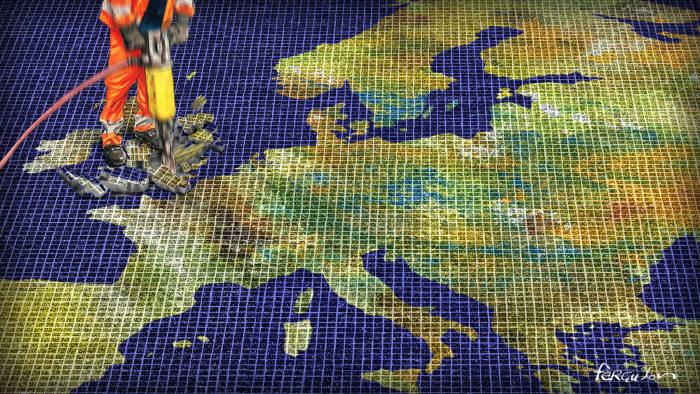
Britain after Brexit will not be alone, but it will be lonelier
“Sajid Javid, chancellor of the exchequer, has told business to abandon calls for regulatory alignment with the EU, stating that they have had three years to prepare. That is nonsense. Nobody has known (or even now knows) what agreement, if any, will be reached. The combination of uncertainty about the outcome with minimal time for adjustment is grotesquely irresponsible.” (Martin Wolf, FT)
Britain heads into the twilight zone
Britain’s Europe minister Christopher Pincher on Tuesday became the last UK minister to attend a meeting of the EU Council. One diplomat even managed to capture Pincher’s departure on video — marking the moment when Britain exited the EU’s corridors of power. Brussels, meanwhile, is spending the week saying goodbye to a country it expects to be talking to incessantly for years, say our Brussels Briefing team.
EU vessels will no longer have automatic access to UK fishing waters (Fiona Harvey, The Guardian)
Post-Brexit migration policy must leave Britain open to the world (Ben Kelly, Reaction)
Keep up with what’s happening in the EU by signing up to our Brussels Briefing newsletter
Hard numbers
Business checks on Irish Sea trade loom as next flashpoint.

Source: Economy - ft.com