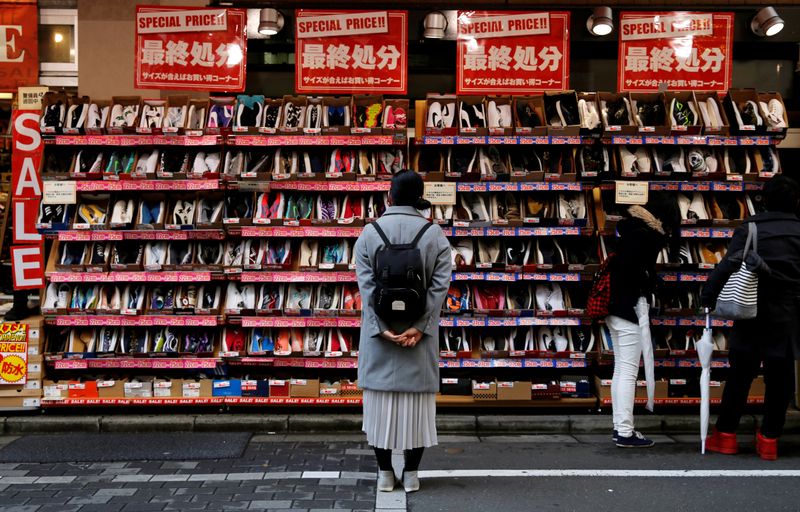
By Tetsushi Kajimoto
TOKYO (Reuters) – Japan’s annual core consumer inflation picked up only slightly in January, keeping the Bank of Japan under pressure to maintain its massive monetary stimulus to support a fragile economy saddled with weak growth and prices.
Stubbornly tame inflation is a worry for the world’s third-largest economy as it grapples with a coronavirus outbreak and weak growth. The Bank of Japan is in no mood to top up its already huge monetary stimulus, fearing it would have little ammunition to battle the next financial crisis.
However, BOJ Governor Haruhiko Kuroda has said he would consider additional easing if the coronavirus outbreak significantly threatens Japan’s economy and inflation, calling the flu-like virus the “biggest uncertainty” for the economy.
The core consumer price index, which includes oil products but excludes volatile fresh food prices, rose 0.8% in the year to January, Ministry of Internal Affairs and Communications data showed. That followed a 0.7% gain in December and matched economists’ median estimate.
The so-called core-core price index, which excludes food and energy prices and is closely watched by the central bank as a narrower gauge of inflation, rose 0.8% in the year to January, it showed.
Stripping out the impact of a sales tax hike to 10% from 8% in October and some other policy steps, the core CPI index rose 0.4% in January from a year earlier and the core-core inflation index rose 0.6%, both unchanged from December, the data showed.
Friday’s data comes after a batch of gloomy indicators this week highlighted a fragile economy. Exports fell again in January, a key gauge of capital spending tumbled the most since 2018, and gross domestic product (GDP) suffered its deepest contraction since the second quarter of 2014.
The Japanese economy shrank an annualized 6.3% in October-December, the biggest drop in nearly six years, as domestic demand took a hit from the tax hike, typhoons and a warm winter.
Some economists expect a contraction in growth this quarter, which will mean a technical recession, as the virus outbreak hits China’s economy – Japan’s largest trading partner and the core of global supply chains.
Fusion Media or anyone involved with Fusion Media will not accept any liability for loss or damage as a result of reliance on the information including data, quotes, charts and buy/sell signals contained within this website. Please be fully informed regarding the risks and costs associated with trading the financial markets, it is one of the riskiest investment forms possible.