Ethereum post-Merge hard forks are here: Now what?

So far, the most important contending networks in favor of the mining community, EthereumPoW and Ethereum Classic, have shown different outcomes post-Merge.Continue Reading on Coin Telegraph More

So far, the most important contending networks in favor of the mining community, EthereumPoW and Ethereum Classic, have shown different outcomes post-Merge.Continue Reading on Coin Telegraph More
The largest bank in Singapore, DBS Group (OTC:DBSDY) Holdings Ltd., is reportedly welcoming new customers to its exclusive cryptocurrency trading service for members. The release states that the move is a response to the growing trend of self-directed investment strategies among the bank’s wealthy clientele.DBS Digital Exchange now supports the trading of tokens such as Bitcoin, Bitcoin Cash, Ether, and XRP for accredited investors in the DBS Treasures segment, which needs investable assets of S$350,000 ($246,000).About 100,000 Singapore residents will have access to the services with a $500 minimum investment amount. Until recently, only corporate and institutional investors, family offices, DBS Private Bank, and DBS Treasures Private Client customers were able to take advantage of the service.As reported by the bank, the number of trades on the digital exchange increased by about four times between April and June, and the amount of Bitcoin purchased increased by nearly as much.This isn’t DBS’s first pro-crypto gesture in recent months. Piyush Gupta, CEO of DBS since 2009, said earlier this month that the recent decline in the value of cryptocurrencies indicated that established and regulated financial institutions, rather than just start-ups, should be offering products like digital asset trading for retail investors.On this note, Gupta added that DBS has to back Singapore’s initiative to develop cutting-edge financial technology.However, the situation for the retail crypto market in Singapore is rather different. In August, the managing director of the Monetary Authority of Singapore, Ravi Menon, indicated that the agency would restrict retail access to cryptocurrencies and investigate “further measures to reduce consumer harm.”Menon did, however, reaffirm the MAS’s confidence in the “transformative” economic potential of the larger digital asset ecosystem, which includes tokenized digital versions of conventional assets.The post Singapore’s Largest Bank Expands its Cryptocurrency Clientelle appeared first on Coin Edition.See original on CoinEdition More
The crypto Twitter (NYSE:TWTR) technical analyst, Michaël van de Poppe, posted on Twitter today that the total market cap of the crypto market is reclaiming the 200-Week Moving Average (MA).
Total crypto market cap (Source: TradingView)The crypto market tracking website, CoinMarketCap, shows that the total crypto market cap has risen 3.53 percent over the last day – taking the total to approximately $947.78 billion.The recent increase in market cap can be attributed to the latest performance of the two crypto market leaders, Bitcoin (BTC) and Ethereum (ETH). Both of the leaders have seen a positive increase in their prices over the past 24 hours, with BTC’s price rising 2.24 percent and ETH’s price climbing 5.11 percent.Currently, Bitcoin’s market cap is standing at $396.65 billion and Ethereum’s market cap is standing at $164.05 billion. Other contributors to the market cap increase are Binance Coin (BNB) with a 3.72 percent increase in price over the past 24 hours – taking its market cap to $44.56 billion.Ripple (XRP) also saw an astonishing price increase of 27.23 percent over the past 24 hours to take its market cap to $26.78 billion.The rest of the top 10 cryptos by market cap, Cardano (ADA), Solana (SOL), and Dogecoin (DOGE) also saw their market caps pick up over the last day. At the time of writing, ADA has a market cap of $15.94 billion, SOL has a market cap of $11.65 billion, and DOGE has a market cap of $8.17 billion.The post Total Crypto Market Cap Reclaims the 200-Week Moving Average appeared first on Coin Edition.See original on CoinEdition More
With the Vasil hard fork, Cardano will improve the Plutus smart contract language for dApp, reduce the latency of block transmission, and introduce “diffusion pipelining” to the blockchain. The main aim of the Vasil upgrade is to prepare the chain for scaling while giving developers more tools and access to information. Dan Gambardello made an explanatory video on his Youtube channel Crypto Capital venture about Cardano’s Vasil upgrade. In the video, Gambardello explained Vasil upgrade contained three Cardano Improvement Proposals (CIP) and “diffusion pipelining.”The three CIPs are CIP 30, CIP 32, and CIP 33, which revolve around datums. CIP-31 introduces a new mechanism for accessing information in datums as a reference input. CIP-32 suggests a solution that allows datums themselves to be attached to outputs instead of datum hashes. CIP-33 introduces the ability to reference a script without including it in each transaction. For the uninitiated, Diffusion pipelining is an improvement to the consensus layer that facilitates faster block propagation. It also enables even greater gains in headroom, which will further increase Cardano’s performance and competitiveness.Furthermore, More than 75% of stake pools were updated to the latest node version, 1.35.3, and 80% of all liquidity providers have also updated to the latest node. All of the top ten DApp developers have updated nodes, smart contracts, and websites.At the time of writing, ADA is priced at $0.456 with a surge of 0.14% in 24 hours but experienced a fall of 1.98% in seven days.The post What Happens to Cardano’s Blockchain After the Vasil Upgrade? appeared first on Coin Edition.See original on CoinEdition More

The People’s Bank of China (PBOC) also said it will also promote a virtuous circulation of onshore and offshore yuan markets, reiterating that it will “resolutely fend off systemic risks,” it said in a yuan internationalisation report published on Friday.The report comes at a time when the currency is facing renewed depreciation pressure, weighed by a buoyant dollar, hawkish Federal Reserve tightening and a slowing economy. [CNY/]China, along with Japan, is among major outliers in a global run of interest rate hikes to tame high inflation, with Beijing focused on reviving the economy hurt by COVID-19 shocks. But such widening policy divergence weighed on the yuan, and prompted overseas investors to cut holdings of Chinese bonds for a seventh consecutive month in August.The PBOC said in the report that it will facilitate overseas investors, especially global central banks and similar institutions, to increase holdings of Chinese assets.China will “improve the liquidity of yuan-denominated financial assets, further facilitate foreign investors’ access to Chinese markets for investments and enrich the variety of assets available for investments,” the central bank said. More
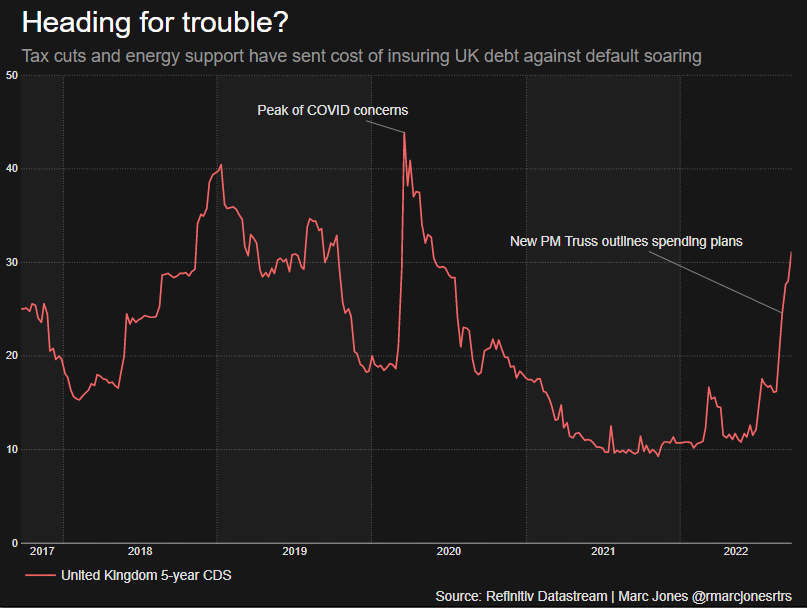
LONDON (Reuters) – Stocks hit two-year lows on Friday, the dollar scaled a two-decade high and bonds sold off again as investors feared bigger interest rate rises are on their way to tame inflation, while UK assets plunged after huge debt-financed tax cuts were announced.UK assets were already weaker but extended their fall after Britain’s new finance minister unveiled an historic tax-cutting agenda that will see government borrowing soar. UK bond yields were set for their biggest daily rise in decades, and money markets were pricing in Bank of England interest rates of as much as 5% by May next year. Sterling lost 2%.The mood on markets has been sour all week, with major central banks delivering another 350 basis points of rate hikes to fight inflation, Japan intervening to prop up the yen and grim purchasing managers index data on Friday pointing to a deepening slowdown in major economies.Rates were hiked in the United States, Britain, Sweden, Switzerland and Norway – among other places – but it was the Federal Reserve’s signal that it expects high U.S. rates to last through 2023 that sparked the latest sell-off.MSCI’s world stocks index fell to its lowest since mid-2020 on Friday, having lost about 12% in the month or so since Fed Chair Jerome Powell made clear that bringing down inflation would hurt.The euro fell for a fourth straight day after data showed the downturn in the German economy has worsened in September, as consumers and businesses face an unprecedented energy crunch and spiralling inflation.European stocks were a sea of red for a second day, under pressure from losses in everything from bank to natural resources and technology shares. (EU)The pan-regional STOXX 600 was down about 2.2%, while Frankfurt’s DAX lost 1.94%, ranking it as one of Europe’s worst-performing indices. “Pretty much anything besides inflation data and central bank policy decisions is just noise at the moment, with the market firmly, and almost solely, focused on how high rates will rise across developed markets, and how long they will remain at those peaks,” Caxton FX chief strategist Michael Brown said.S&P emini futures fell 1.15%, suggesting a weaker start on Wall Street later.London’s FTSE lost 1.9%, against a backdrop of the pound tumbling 2% to another 37-year low and as weak as $1.1022 at one point. The cost of insuring UK debt against default also jumped. GRAPHIC – Cost of insuring UK debt against default soars “Typically looser fiscal and tighter monetary policy is a positive mix for a currency – if it can be confidently funded,” said Chris Turner, global head of markets at ING: “Here is the rub – investors have doubts about the UK’s ability to fund this package, hence the gilt under-performance.”KING DOLLARWith U.S. rates set to rise faster and stay high for longer, the dollar hit its highest in two decades and extended its double-digit gains for the year against several currencies. The Swedish crown, sensitive to the global investor mood, has this week repeatedly dropped against the dollar to its weakest since at least the early 1970s, Refinitiv data showed. GRAPHIC – King dollar reigns supremehttps://fingfx.thomsonreuters.com/gfx/mkt/lbvgnkkylpq/Pasted%20image%201663851778713.png Yields on the benchmark 10-year U.S. Treasury note have soared as investors ditch inflation-sensitive assets like bonds. The 10-year yield rose 5 basis points to 3.776%, another 11-1/2 year high and on course for its eighth consecutive weekly increase.Euro zone bond yields also rose sharply, with the Italian 10-year hitting 4.294%, its highest since late 2013, ahead of Italian elections on Sunday. The euro marked another 20-year low, plunging as far as $0.9736. The Japanese yen fell sharply on Thursday until Japanese authorities stepped in to buy the currency for the first time since 1998 and arrest its long slide.On Friday the yen gave up some of its gains, with the dollar up 0.4% at 142.97 yen per dollar. Few believe the yen rally will hold given how dovish the Bank of Japan remains.Gold, which pays no interest, has come under pressure, particularly over the course of this quarter, as yields have risen. It was last down 1.55% on the day around $1,644 an ounce, at its weakest in two years. More
Helium’s community members recently completed a vote to shift the Helium network to the Solana (SOL) blockchain. This move will transfer all of the tokens, applications and governance to the Solana blockchain.The voting for the “Scaling the Helium Network” proposal closed yesterday (September 22, 2022) with a total of 7,447 votes. Out of these votes, 6,177 (81.41%) were in favor of the network change, while 18.59% voted against it.Developers behind the Helium project proposed this migration as a means of scaling the protocol. The goal behind the proposal is to enable more efficient transactions as well as achieve a higher level of interoperability within the Helium network.There are three major changes that are included in the HIP70 proposal. These changes include moving Proof of Coverage Oracles, moving data transfer accounting to Oracles, and migrating the whole Helium network to the Solana (SOL) blockchain.The network’s native token, HNT, is trading at $4.64 at the time of writing according to the crypto market tracking website, CoinMarketCap. This follows after a 3.23% decrease in price over the last 24 hours. Additionally, HNT has weakened against Ethereum (ETH) and Bitcoin (BTC) by 5.39% and 2.83% respectively.In terms of market cap, HNT’s market cap is $587,259,081 – ranking it as the 66th biggest project by market cap. Ranked above it is NEO, with FTM positioned one position below it.The 24-hour trading volume for HNT has also fallen by 48.31% compared to the day prior – taking the total to $22,863,939.The post HNT Update: Helium Proposal to Migrate HNT to Solana Completed appeared first on Coin Edition.See original on CoinEdition More
Airbus has backed itself to meet its target of delivering about 700 aircraft by the end of the year but warned it would be “anything but a walk in the park” as the aviation industry continues to battle supply chain constraints. The world’s largest plane maker said on Friday that it was grappling with “multiple crises” but that issues around the supply chain were its greatest challenge. Like other global manufacturers, Airbus has struggled with shortages of raw materials, electronic components and the availability of labour, just as demand has rebounded in the wake of the coronavirus pandemic. Soaring inflation, uncertainty over the war in Ukraine and energy costs have deepened the pressures. Dominik Asam, Airbus chief financial officer, said the company had delivered 382 aircraft through to the end of August, leaving about 320 planes still to be delivered to meet the target. The company, Asam told a capital markets briefing on Friday, was “fully engaged” to deliver on its commitments, “yet against the backdrop of disruptions in global supply chains, delivering around 700 aircraft in 2022 is anything but a walk in the park”.Airbus in July cut its original year-end delivery target from 720 to “around 700” aircraft. It also adjusted the planned output of its best-selling A320 family of jets for this year and next. The company said it was targeting a monthly production rate of 65 in early 2024 — some six months later than originally forecast. Airbus at the time, however, said it was sticking with its plan to get to a monthly rate of 75 jets by 2025.Guillaume Faury, Airbus chief executive, on Friday reiterated the rate of 75 jets a month. The company expects to be producing about 50 a month by the end of this year. “Based on the visibility we have now from the supply chain we think it’s manageable, but I will not tell you that it’s easy,” Faury said of the 700-plane target. “There’s a hell of a lot of work to be done,” he added, noting that Airbus expects the crisis to persist into next year. The bottleneck in the supply of engines, however, which has been a cause of friction between Airbus and engine makers including CFM International, a joint venture between Safran and GE, is easing. The number of “gliders” — aircraft that have been built but are sitting in storage without engines — had reduced to single figures, said Faury, from 26 in July. The company has reached agreement on engine volumes with both CFM International and Pratt & Whitney for 2023 and 2024 and had started talks about numbers for 2025. More