More stories

  • in

    How the Ukraine-Russia war rattled global financial markets

    https://graphics.reuters.com/UKRAINECRISIS-SIXMONTHS/egvbkdgeapq/chart.png

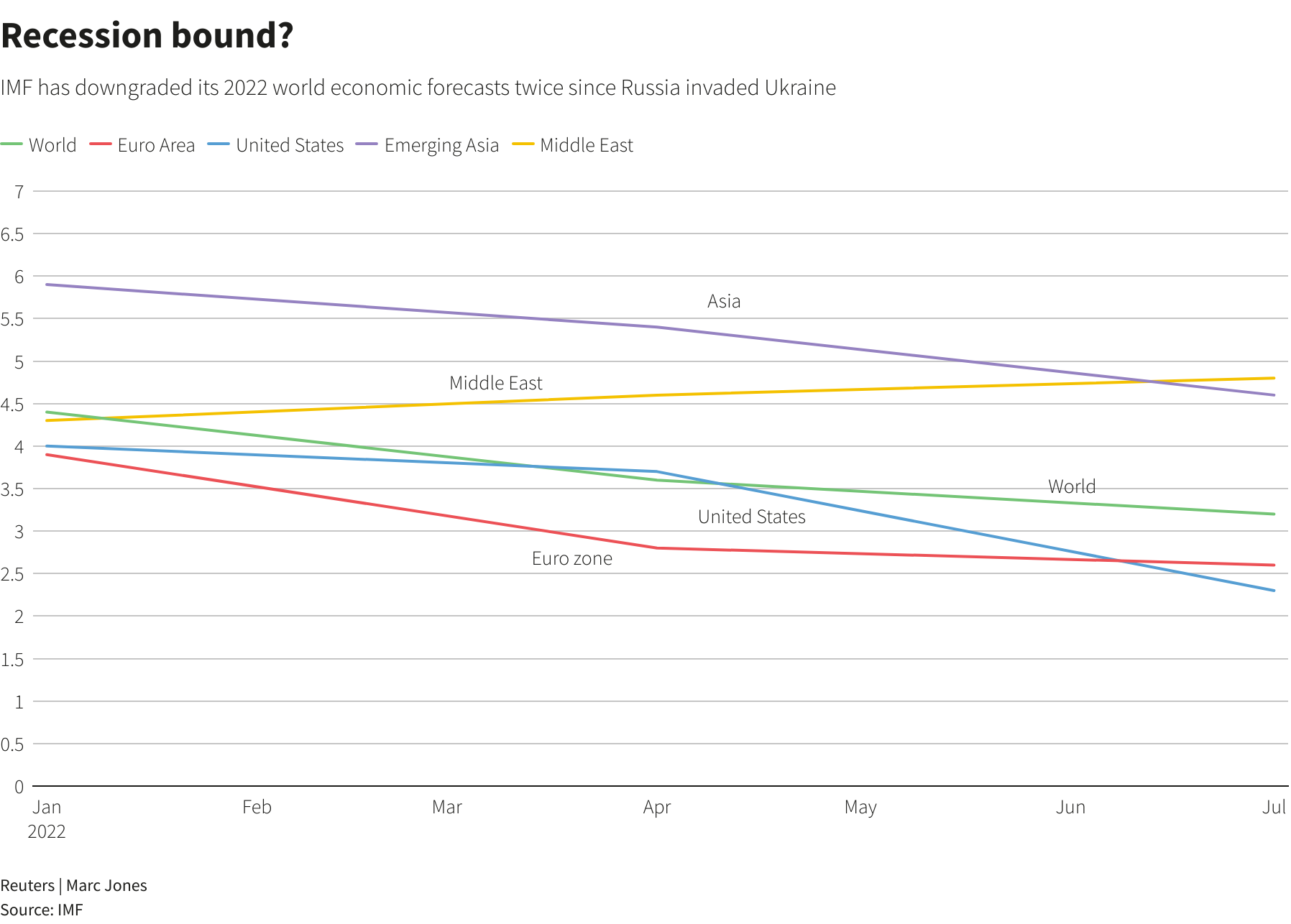
    LONDON (Reuters) – Over six months since Russia invaded Ukraine in what Moscow calls its “special military operation” thousands have been killed, millions made homeless and the world has seen the worst East-West tensions since the Cold War.It has also thrown global financial markets into severe turmoil as the charts below show.1/RECESSION FEARSRecessions now look almost certain in Europe as prices of gas, critical for households and industry, more than trebled since June alone on fears Russia will cut off its supplies, possibly leading to energy rationing in some economies. Yet the European Central Bank, the Bank of England and other central banks are determined to crush the inflation spiralling energy costs are fuelling, even if higher interest rates are bound to further squeeze households and companies struggling with rising costs. GRAPHIC – Recession bound? 2/GROWING PAINSAgricultural markets whipsawed after the invasion but have proved remarkably flexible since. Wheat and corn – Ukraine and Russia’s key exports – have swooped right back down after an initial price surge, while Moscow’s main source of income, oil, is now fetching less than when the invasion started. GRAPHIC – Six months of the Ukraine warhttps://fingfx.thomsonreuters.com/gfx/mkt/mypmneyobvr/Pasted%20image%201660815413565.png 3/INFLATION PALPITATIONSThe surge in energy and food prices, in combination with post-pandemic supply chain strains, have driven inflation rates around the world to levels last seen in the 1970s. This has had widespread ramifications for bond markets especially where borrowing costs have ballooned and default worries deepened. GRAPHIC – Inflation palpitationshttps://fingfx.thomsonreuters.com/gfx/mkt/lgvdwybdwpo/Pasted%20image%201661272612465.png 4/EURO TRASHEDThe euro is down more than 12% so far this year, more than over any comparable period in the years since its introduction in 1999, reflecting the view that further cuts in supplies of Russian gas will hit particularly hard major euro zone economies that depend on it, such as Germany and Italy. GRAPHIC – Euro trashedhttps://fingfx.thomsonreuters.com/gfx/mkt/mypmnerqqvr/Pasted%20image%201661248285941.png 5/OUT OF GAS Russian gas flows through major pipelines to Europe have fallen around 75% since the start of the year leading to accusations by top European politicians that Moscow is weaponising its natural resources.Russia has denied the cuts are premeditated, but the fact they are happening and that the EU relied on Russia for 40% of its gas before the invasion, has propelled its price to 270 euros/MWh from under 50 euros/MWh this time last year. GRAPHIC – Russia pipeline gas supplies to Europehttps://graphics.reuters.com/UKRAINE-CRSIS/RUSSIA/movangrozpa/chart.png GRAPHIC – UK gas price futureshttps://fingfx.thomsonreuters.com/gfx/mkt/znpnergmavl/Pasted%20image%201661255390184.png 6/UNDERPERFORMERS Germany’s and Italy’s reliance on Russia made their stock markets among the world’s worst performers. Those close to the fighting, including Poland and Hungary, also saw their equities and currencies pummelled. Bonds of countries with high gas or wheat import bills, took a beating too. GRAPHIC – CEE currencies crushed by crisishttps://fingfx.thomsonreuters.com/gfx/mkt/dwpkrwmwevm/Pasted%20image%201661269761912.png Graphic – German, Italian and CEE indexes underperformhttps://fingfx.thomsonreuters.com/gfx/mkt/byvrjydzqve/Pasted%20image%201661177882724.png 7/CHEMICALS AND CAR PARTSShares of chemical companies have suffered some of the biggest declines since the invasion, since natural gas plays a key role in their manufacturing process. Car parts makers have also been hit hard, partly because Russia was a major market for firms such as VW and Mercedes and partly because Ukraine and Russia have also been suppliers.”European Chemical companies have had a bit of a torrid time,” said Mirabaud equity analyst William Mileham. “There have been production stoppages, and discussions around potential gas rationing have hit their share prices hard recently.” GRAPHIC – Chemicals and car parts makers hammered by Russia Ukraine warhttps://fingfx.thomsonreuters.com/gfx/mkt/lbpgnaxxgvq/Pasted%20image%201661262372473.png 8/VOLATILE TIMESVolatility gauges for markets from stocks and bonds to oil and the euro-dollar exchange rate soared in the wake of the Feb. 24 invasion before a bumpy ride down later on. But they spiked again this month as the energy and recession worries have mounted again. Graphic – Volatility gauges erupthttps://fingfx.thomsonreuters.com/gfx/mkt/zgvomgdxgvd/Pasted%20image%201661266750960.png 9/FALLING RATINGSThe war has been mentioned as a factor in nearly 250 S&P Global (NYSE:SPGI) credit rating downgrades or outlook cuts since late February. Russian borrowers accounted for over half of them, but rising energy and borrowing costs mean the impact will continue to spread wider.Ukraine has defaulted as the war has wrecked its economy and finances. Sanctions have also pushed Russia into its first sovereign debt default in decades and left over $25 billion of the country’s corporate debt unpaid.”Russian corporates have shown a very strong willingness to keep paying foreign creditors, even with the obstacles that sanctions have placed upon them,” Jeff Grills at Aegon (NYSE:AEG) Asset Management added, though. GRAPHIC – Credit rating moves linked to Russia-Ukraine war fallouthttps://fingfx.thomsonreuters.com/gfx/mkt/zgpomgddqpd/Pasted%20image%201661263507575.png 10/CORPORATE EXODUSBig brands from Nike (NYSE:NKE) and Coca-Cola (NYSE:KO) to IKEA and Apple (NASDAQ:AAPL) are among over 1,000 global firms that have exited Russia or made public plans to scale back their activities there, according to a list https://som.yale.edu/story/2022/over-1000-companies-have-curtailed-operations-russia-some-remain?company=shell&country= compiled by researchers at Yale.It adds up to billions of dollars worth of assets. But others have either stayed or maintained https://moralratingagency.org what they have described as essential or unsellable parts of their businesses in Russia.”We have never seen anything of this magnitude in economic history,” said Jeffrey Sonnenfeld, Senior Associate Dean for Leadership Studies at Yale, who has led the project. GRAPHIC – Companies pulling out of Russiahttps://fingfx.thomsonreuters.com/gfx/mkt/zdpxozebgvx/Pasted%20image%201661265033239.png More


  • in

    Fed's Kashkari says his biggest fear is inflation will be more persistent

    Kashkari is already the most hawkish of all the central bank’s 19 policymakers and expects the Fed to need to lift its policy rate, now at 2.25%-2.5%, another two full percentage points by the end of next year.”The big fear that I have in the back of my mind is, if we are wrong and markets are wrong and that this inflation is much more embedded at a much higher level than we appreciate or markets appreciate, then we are going to have to be more aggressive than I anticipate, probably for longer, to bring inflation back down,” Kashkari said.Right now, he said, it’s “very clear” the Fed needs to tighten monetary policy.If inflation were at 4%, he said, the Fed could afford to go slow on rate hikes to make sure it doesn’t overdo it and send the economy into a downturn.But with inflation as high as it is, he said the Fed needed “to err on making sure we are getting inflation and only relax when we see compelling evidence that inflation is well on its way back down to 2%.”Kashkari says his biggest concern is that if the Fed is “misreading the underlying inflation dynamics, then it’s going to take us a while probably to figure that out, and then we are going to have to be even more hawkish than I am envisioning right now.” More

  • in

    U.S. to extend baby formula waivers for poor families through year-end

    (Reuters) -The Biden administration will extend through year end waivers that make it easier for low-income families to access baby formula through a government program, the U.S. Department of Agriculture (USDA) plans to announce on Tuesday.Earlier this year, the USDA started covering the difference in costs for states to offer a broader range of infant formula products for low-income families, after the closure of Abbott Laboratories (NYSE:ABT)’ Michigan plant exacerbated a national shortage of the vital product.The plant was initially closed due to complaints of bacterial contamination.The current waivers are set to expire on Sept. 30 and the extension will help the government avoid a steep drop in infant formula access as shortages linger in pockets across the country.Reuters was first to report the duration of the extension but Politico reported earlier on Tuesday that an extension was likely.Infants enrolled in the government’s WIC (women, infants and children) program consumed about 56% of all infant formula in the United States in 2018.WIC shoppers typically can only buy formula produced by the company that has a contract with their state, territory, or tribe. Those companies provide rebates to cut the cost of formula to WIC shoppers.Abbott Laboratories, the biggest participant in the WIC program, said on Tuesday it is extending rebates on competitive products to help low-income families through Oct. 31. More

  • in

    S&P 500 seen a little higher by end of 2022 -strategists

    NEW YORK (Reuters) – The S&P 500 will end the year a little above its current level after a recent rally that has lifted the index from its bear market lows, according to a new Reuters poll of strategists.Stronger-than-expected corporate earnings and forecasts, along with optimism the U.S. Federal Reserve may avoid crippling the economy as it hikes interest rates in its fight against decades-high inflation, have lifted the S&P 500 about 13% from lows in mid-June.The benchmark will end this year at 4,280, according to the median forecast of nearly 50 strategists polled by Reuters during the last two weeks. That is 3.4% higher than Monday’s close of 4,137.99. That median forecast for 2022 was down from a forecast of 4,400 in a Reuters poll conducted in late May.Strategists in the latest Reuters poll expected the S&P 500 to continue to rise in 2023, and hit 4,408 by mid-year, according to the poll’s median forecast. Professional investors and analysts have historically had poor track records predicting stock market returns, but their forecasts provide a valuable glimpse of sentiment on Wall Street. The S&P 500 remains down about 13% this year so far after tumbling into its second bear market since the 2020 global sell-off caused by the coronavirus pandemic.Slightly over half the strategists in the poll expected more downside risks to their forecast than upside, while most strategists polled expected market volatility to rise rather than decline in the coming three months.”Going into September, that’s a murky month for equities,” said Peter Cardillo, chief market economist at Spartan Capital Securities in New York. “I would suggest we could then see a pullback somewhat, but nothing that would suggest we would make new lows, because I believe the market has made a low.” Cardillo sees the S&P 500 ending the year at 4,350.”Toward the end of the year, we could begin to rally. The Fed is not going to get overly aggressive. I see signs of inflation coming down, and I believe the labor market will soon begin to weaken, and that should alleviate the Fed from getting overly aggressive.”The Fed has lifted its benchmark overnight interest rate by 2.25 percentage points this year as it tries to curb decades-high inflation, and investors continue to weigh how aggressive the U.S. central bank may need to be going forward.Investors are hoping the Fed may shed light on how big future rate hikes might be and how strong the economy is when central banking heavyweights, including Fed Chair Jerome Powell, meet this week for their annual symposium in Jackson Hole, Wyoming.”We say there’s a 50/50 chance there’s going to be recession next year. Will the Fed stay active if we go into a recession? That’s what we don’t know,” said John Augustine, chief investment officer at Huntington National Bank in Columbus, Ohio. “We have to hear more from Powell.”Recent corporate earnings have supported stocks. With results in from most of S&P 500 companies, second-quarter earnings are expected to have climbed 8.8% from a year ago, above the 5.6% estimated on July 1, according to IBES data from Refinitiv IBES.Analysts’ estimates for full-year profit growth have come down slightly since the start of July, but they still forecast growth of 8% for 2022, the data showed.Investors have worried whether profits can grow fast enough to support stock valuations, especially with the recent rally. The S&P 500’s forward 12-month price-to-earnings ratio is now at about 18 compared with 22 at the end of December and its long-term average of about 16, according to Refinitiv data.Based on the poll, the Dow Jones industrial average will finish the year at 34,200, up about 3.4% from Monday’s close. More

  • in

    Crypto trader doubles portfolio in a month betting against Jim Cramer

    In his latest tweet on Monday, the trader, who became famous on Twitter (NYSE:TWTR) for pre-empting the fall of Terra’s collapse earlier this year, said he has just flipped to a long position on his inverse Jim Cramer account following a bearish tweet from Cramer about the state of the Nasdaq.Continue Reading on Coin Telegraph More

  • in

    Cryptoverse: A mixer with your crypto cocktail?

    (Reuters) – The DeFi dream is shaken. And stirred.The grand crypto project has declined in 2022: total user funds deposited in decentralized finance has shrunk to about $61 billion from over $170 billion at the start of the year, according to figures from data aggregator Defi Llama. In a fresh jolt, the U.S. Treasury has sanctioned one of the industry’s biggest “mixers”, tools that pool and scramble crypto from thousands of addresses to boost anonymity, saying it was used by hackers to launder their gains. The U.S. intervention this month has forced many DeFi projects to block cash from wallets linked to the Ethereum-based mixer, Tornado Cash, representing a blow to those devotees who dream of a brave new world free of central authority.”The motion has set back DeFi in its ability to be decentralized and operate in a censorship resistant way,” said Katie Talati, director of research at digital asset manager Arca. Indeed, the market impact could be significant, given the growing role of mixers, whose proponents argue they serve a legitimate use in creating privacy and say specific users should be targeted by authorities rather than an entire code.The average usage of such services over a 30-day period hit an all-time high of $51.8 million in late April, roughly double the level a year before, according to a Chainalysis study in July, before declining with the broader crypto market. “This makes sense given that the timing coincides with DeFi’s increasing prominence within the overall cryptocurrency ecosystem,” Chainalysis researchers wrote. Tornado Cash didn’t respond to a request for comment on the sanctions. LOCKED AND CODEDAave and Uniswap, two of the most popular DeFi platforms that blocked wallets linked to Tornado, have seen user funds, or total value locked (TVL), drop since the sanctions were imposed – $6.4 billion from over $6.9 billion for Aave, and $5.7 billon from $6.5 billion for Uniswap, according to Defi Llama. This may not be all due to Tornado, as most cryptocurrencies have suffered heavy losses in the past week and the DeFi sector has seen little change in activity – for example, Uniswap says its weekly trading volumes have remained fairly steady at around $8 billion.”TVL has decreased, but at the same time the price of tokens has decreased,” said Max Krupyshev, CEO of payments provider CoinsPaid. “People didn’t pull money out so much as the value of their investments went down.”Aave and Uniswap also didn’t respond to requests for comment on mixers. Graphic: Mixture troubles – https://graphics.reuters.com/FINTECH-CRYPTO/WEEKLY/zdpxozwzlvx/chart.png BIG CATS PROWL?While DeFi players may face tough decisions on whether to pull back from mixers, some watchers spy a potential upside for the market should the U.S. measures encourage traditional institutional investors to join the fray. “Larger institutions may see the sanctions as a step towards legitimacy, potentially giving them more comfort in engaging with or investing in Ethereum and other digital assets,” analysts at digital asset manager Grayscale wrote. In the immediate future, though, little is certain.”Illicit” addresses identified by data firm Chainalysis accounted for 23% of funds sent to mixers in 2022, rising from 12% in 2021. As for Tornado Cash specifically, analytics firm Elliptic reported that at least $1.54 billion in criminal proceeds were laundered through the platform. Arca’s Talati thinks we haven’t seen the end of crackdowns on mixers. “Tornado Cash is one of the ones that’s been around the longest,” she said. “This isn’t the last thing we’re going to see.” More

  • in

    Britain and Ukraine launch talks on digital trade

    Britain in May removed all tariffs on Ukrainian goods, and is now looking to smooth trade in the digital sphere.”The UK stands shoulder to shoulder with Ukraine and will use trade as a force for good to help the country rebuild its modern economy after this barbaric war,” trade minister Anne-Marie Trevelyan said.”Our partnership with Ukraine will help them seize the brighter days ahead, and we will continue to do everything in our power to protect Ukrainian jobs, livelihoods and families.”  Britain and Ukraine will look to improve efficiency in digital trade, working on areas such as electronic transactions, e-signatures and other technology. British exports of digitally delivered services accounted for nearly three quarters of UK services exports to Ukraine in 2020, the trade ministry said.  More