More stories

  • in

    Alf Protocol Gains Support from Famous Venture Capitalist, Enables LP to Earn More

    The crypto world continues developing and expanding its reach through a strategic partnership with venture capitalists across the space. This time, Alf protocol partnered with various VCs to drive the future development of the protocol.In terms of technology, the Alf network is a protocol for capital deployment on Solana’s liquidity provision and yield farming both with and without a margin of up to 200x. The Alf protocol’s way of enabling the liquidity providers to make easy money also allows them to increase the value of the entire network.The venture capitalists invested in the network include ZenCapital, DustVentures, DibVentures, and Scorpio. These private investors will back the Alf protocol on its journey in the crypto industry.Meanwhile, the VC’s that supported the Alf protocol are all unique in their own ways. First, Zen Capital, focuses on decentralized finance, metaverses, and blockchain-powered gaming. Second, Dust Ventures, a venture capital firm that invests in cryptocurrency startups and promising projects.Third, Dib Ventures, is an investment firm exclusively for blockchain technology and the digital currency ecosystem. Last but not least, Scorpio, the company that operates short-term quantitative funds, digital asset funds, blockchain product development, supernode operations, e-commerce, culture communication, real estate development, and real economy projects. On the other hand, Alf network will still continue to expand its reach in the space to provide the best user experience to all its participants and investors.Disclaimer: The views and opinions expressed in this article are solely the author’s and do not necessarily reflect the views of CoinQuora. No information in this article should be interpreted as investment advice. CoinQuora encourages all users to do their own research before investing in cryptocurrencies.Continue reading on CoinQuora More


  • in

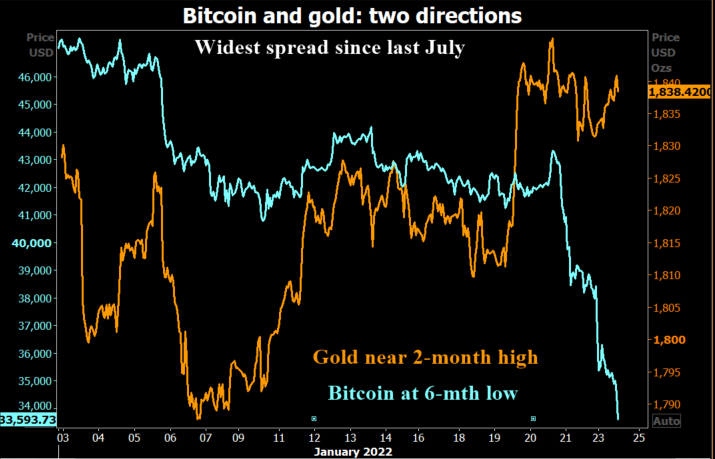
    Bitcoin skids to six-month low as fears of Ukraine conflict shake markets

    https://fingfx.thomsonreuters.com/gfx/mkt/lgvdwjdoapo/btc.PNG

    LONDON (Reuters) – Bitcoin tumbled almost 9% on Monday to its lowest in six months as fears of a Russian attack on Ukraine saw riskier assets worldwide extend their sell-off. The largest cryptocurrency was trading down 8.8% at $33,058, its lowest since July 23, taking losses from its all-time high of $69,000 hit in November past 50%.The U.S. State Department said on Sunday it was ordering diplomats’ family members to leave Ukraine in one of the clearest signs yet that American officials are bracing for an aggressive Russian move in the region.Fears of conflict pummelled shares across the world while bolstering the dollar and oil. Nerves over the U.S. Federal Reserve’s two-day meeting, starting on Tuesday, added to the mix, with the central bank expected to confirm it will soon start draining the pool of liquidity that has supercharged growth stocks.Smaller cryptocurrencies, which tend to move in tandem with bitcoin, also slumped. Second-largest digital coin ether fell 13% to $2,202, its lowest since July 27. Binance Coin, the fourth-biggest token that is issued by the eponymous crypto exchange, was down 12%. “Bitcoin will face headwinds going back up until the macroeconomic conditions change,” said Mark Elenowitz, president of Horizon, a firm that services securities exchanges. “Generally speaking, when rates are hiked, we could see more sell-offs of seemingly risk-on assets like bitcoin.”U.S.-listed cryptocurrency miners Riot Blockchain (NASDAQ:RIOT), Marathon Digital and Bit Digital slumped between 7.3% and 12% in premarket trading, while crypto exchange Coinbase (NASDAQ:COIN) Global dropped 7.8%. GRAPHIC – Bitcoin/gold More

  • in

    German economy likely shrunk in Q4: Bundesbank

    Growth in Europe’s biggest economy stalled in the autumn as supply shortages and shipping bottlenecks held back its vast industrial sector, even as consumption held up relatively well. But household consumption also took a hit late in the year over fears about the Omicron variant, which forced businesses to bring back restrictions on activity.”The adjustments in behaviour and the triggered containment measures in some cases had a significant impact on economic activity in the service sector, especially in December,” the Bundesbank said.”Germany’s real gross domestic product is likely to have fallen slightly in the final quarter of 2021.” The outlook for the new year appears to be brighter, however, after strong factory output growth, helped by easing supply bottlenecks, pushed activity in manufacturing to a five-month high in January, separate data showed on Monday.Inflation prospects, however, may take longer to improve, the Bundesbank said, warning that price growth could remain “exceptionally high” in early 2022 due to soaring energy costs and delivery bottlenecks. German inflation hit 5.7% in December and the Bundesbank sees it above the European Central Bank’s 2% target at least through 2024. More

  • in

    Analysis-A digital dollar is years away as U.S. Fed kicks issue to Congress

    WASHINGTON (Reuters) – While the Federal Reserve’s paper on potentially adopting a central bank digital currency (CBDC) will advance debate in Washington, its decision to kick the issue to Congress means an official U.S. digital dollar is still several years away.The U.S. central bank on Thursday released a much-anticipated paper on the pros and cons of adopting a digital dollar, a digital version of cash in your pocket, in which it refused to take a stance and said Congress should decide the matter.Many CBDC enthusiasts saw the report as a key milestone in developing some form of digital dollar policy, but with lawmakers confused and divided on the issue — even within their own parties — analysts said they should not hold their breath.”The paper … is light on conclusions and reinforces our view that a Fed-backed CBDC is — at best — years away from launch,” Isaac Boltansky, director of policy research for brokerage BTIG, wrote in a note. “We are bearish on a legislative solution emerging.”Unlike cryptocurrencies, which are run by private actors, a CBDC would be issued and backed by the central bank. It would differ from electronic transactions that happen through large commercial banks by giving consumers a direct claim to the central bank, similar to physical cash.A digital dollar could transform the financial system, speeding up payments globally and giving consumers greater access to the financial system, the Fed said. But it cautioned that a poorly designed digital dollar could weaken banks, destabilize the financial system and create privacy issues. About 90 countries https://www.atlanticcouncil.org/cbdctracker, including China, are exploring or launching their own CBDCs, according to the Atlantic Council, sparking concern among some that the United States will cede the dominance of the global financial system if it does not digitize the dollar, currently the global reserve currency.In an already fiercely divided political climate, reaching a consensus on this tangle of thorny issues “seems like a long shot,” JPMorgan (NYSE:JPM) chief economist Michael Feroli wrote in a note.While some Republicans are eager for the Fed to embrace innovative technology, others have expressed concern over the central bank expanding its footprint and competing with private banks. “I’m genuinely undecided whether there is a legitimate need for a CBDC,” Republican U.S. Senator Cynthia Lummis, a leading digital currency proponent, tweeted following the Fed’s report.Some Democratic progressives like Senate Banking Committee Chairman Sherrod Brown support a digital dollar that would boost financial inclusion, but other Democrats have flagged concerns that a digital dollar could be used for illicit purposes. Brown, who would play a leading role in drawing up legislation in the thinly divided Senate, said on Thursday that the report was a “a good first step,” while some other lawmakers said they were looking forward to working on legislation.But even if Congress was able to agree on and pass legislation this year, the rollout of a digital dollar would require a lengthy pilot and implementation phase. “Even if you start today, we’re still going to be a couple of years away from this becoming a reality,” said Jonathan McCollum, chair of federal government relations for Davidoff Hutcher & Citron, who has lobbied lawmakers to get started.As lawmakers, regulators and the White House debate the issue, the private sector is likely to move ahead with products that may weaken the argument for a digital dollar, Ian Katz, managing director of Capital Alpha Partners, said in a note.”If it finally happens years down the road, a Fed CBDC would be less of a world-changer than it would be now,” he added. More

  • in

    Fed tries to match economic risks against market's rush to tighten

    WASHINGTON (Reuters) – The Federal Reserve may not raise interest rates until March, but officials’ tougher language about inflation is already kicking in, with borrowing costs rising for everyone from homebuyers to the federal government and stock markets kicking off the year deep in the red.The pace of that adjustment now poses an unexpectedly urgent question for U.S. central bank officials at their latest two-day policy meeting this week: Are financial markets tightening too fast for what the Fed intends in its inflation battle, or is the Fed the one underestimating what will ultimately be needed to slow the pace of price increases https://graphics.reuters.com/USA-FED/INFLATION/zdpxoqkrkvx/index.html? In their most recent projections, issued in December, policymakers said they expected as many as three quarter-percentage-point rate increases this year, with more in the cards in 2023 and 2024. But those projections never raise the Fed’s benchmark overnight interest rate above the “neutral” level that would actually restrict the economy.Yet inflation still falls, a best-of-all-worlds outcome some analysts see as unrealistic.”The U.S. is facing the highest inflation since 1982 and there is compelling evidence that a good chunk of it will persist. The Fed has never responded this slowly … and even today is signaling a benign hiking cycle,” wrote Ethan Harris, the head of global research at Bank of America (NYSE:BAC). “The biggest near-term risk is right in front of us: that the Fed is seriously behind the curve and has to get serious.” That could mean as many as six quarter-percentage point rate increases this year, he said, and a fast push to a 3% federal funds rate from the current level near zero. That’d be the highest policy rate since the Fed started slashing borrowing costs at the start of the 2007-2009 financial crisis, and enough, according to current estimates, to actually curb economic growth, employment and inflation.In the Fed’s current projections they merely do less to prop it up.Fed officials won’t update their formal outlook at the Jan. 25-26 policy meeting. But Fed Chair Jerome Powell will hold a news conference after the release of the policy statement on Wednesday to talk in more detail about the Fed’s plans, the current view of the economy, and the recent resetting of rates and equity values. That has included a more than 7% decline in the S&P 500 index since Dec. 31.’SHADOW’ RATE HIKESFor a central bank that just a few months ago still promised open-ended support until the economy was fully healed from the coronavirus pandemic, the surge in U.S. inflation to a 40-year high kickstarted a high-stakes policy shift away from pandemic support. The COVID inflation surge The COVID inflation surge https://graphics.reuters.com/USA-FED/INFLATION/akvezawxopr/chart.png A “liftoff” of interest rates has been flagged for March, years ahead of what was thought likely at the start of the health crisis. At the same time, the Fed is planning to shrink https://graphics.reuters.com/USA-FED/BALANCESHEET/byprjmwezpe/index.html its holdings of U.S. Treasury bonds and mortgage-backed securities – using a second lever to ratchet up the cost of credit.How the two policy tools interact remains a topic of analysis and debate – as does the eventual influence on inflation, the variable the Fed ultimately is trying to control.Even with three rate increases and a smaller balance sheet in the offing, investors so far are assuming the Fed will have to do more to bring price increases back into line with its 2% inflation target. Trading in futures contracts linked to the federal funds rate shows four rate increases expected this year, for example, and is edging towards five. Rising rates https://graphics.reuters.com/USA-FED/RATES/zgpomaxjqpd/chart.png On the basis of comments from Fed officials and the sharp tone of the minutes from the central bank’s Dec. 14-15 meeting, interest rates for home mortgages, corporate credit and U.S. Treasury debt are already rising as a result.Indicators of overall financial conditions – showing how easy or hard it is for households and firms to borrow – have tightened slightly since the Fed began trimming its monthly bond purchases last fall and as the talk around inflation turned more urgent. An estimate of the “shadow” federal funds rate maintained by the Atlanta Fed shows that as of the end of 2021 changes in market interest rates already had produced the equivalent of a 0.6 percentage-point rate hike.OMICRON DRAGStill, overall financial conditions remain loose by historic standards. Even if that seems out of step with inflation, there are reasons for the Fed to be reluctant about change coming too fast. The pandemic continues. While some health officials expect the current outbreak driven by the Omicron variant to subside soon, for now it has slowed hiring and tamped down the economic recovery.Some economists now predict the U.S. economy will end up having lost jobs in both January and February. That would leave the Fed with the tough choice of raising interest rates in March in the face of declining employment.Even a temporary Omicron-related “dip” keeps alive concerns that the Fed this year will face not the best, but the worst of both worlds in the form of a slowing economy and inflation that needs even tougher medicine than officials have yet prepared to deliver.In an interview this month ahead of the Fed’s pre-meeting blackout period, Atlanta Fed President Raphael Bostic said the depth of the dilemma turns in part on the degree to which inflation falls on its own, without the need of restrictive Fed policy to force it down through slower growth and slowed employment.That could happen if, as some economists expect, the virus eases and more workers return to jobs – boosting the supply of goods and services and easing the pace of wage hikes – or if global supply disruptions subside.There is, however, no guarantee.Before the onset of the coronavirus, the Fed was struggling against dynamics that kept inflation perennially below its 2% target, and “there is a narrative that says once we are past the pandemic those forces take over so you don’t need as aggressive a policy posture,” Bostic said. But “none of us going into the pandemic contemplated that inflation would be as high as it is now. So the question really is how forcefully or fulsomely do we have to respond?” More

  • in

    Omicron hits eurozone business despite fewer supply chain snags, PMIs show

    Eurozone businesses reported a weaker than expected start to the year with activity growing at its slowest rate for 11 months despite an easing of the supply bottlenecks holding back manufacturers, according to a closely watched survey.The IHS Markit flash eurozone composite purchasing managers’ index, a monthly poll that takes the pulse of business activity, slowed slightly more than most economists expected to 52.4, down from 53.3 in the previous month.A PMI score above 50 indicates that a majority of businesses are reporting higher activity levels than a month ago. But the survey results suggest the eurozone could emerge in worse shape than expected from the latest surge in infections with the Omicron coronavirus variant.“While the Omicron wave has dented prospects in the service sector, the impact so far looks less severe than prior waves,” said Chris Williamson, chief business economist at IHS Markit. “Meanwhile, perceived prospects have improved among manufacturers, linked to fewer supply shortages, adding to the brightening outlook.”Businesses also reported that average prices charged for goods and services had risen at the fastest rate since the survey started in 2002, indicating that inflation was likely to remain high at the start of this year after hitting a eurozone record of 5 per cent in December.While infection rates across the 19 countries that share the euro have risen to their highest levels since the pandemic began, cinema ticket sales, hotel bookings, job postings and mobility data have fallen far less than in previous surges caused by the coronavirus.Yet services businesses in the bloc said tightened coronavirus restrictions had weighed on demand — particularly in consumer-facing and hospitality sectors — while staff absences due to Covid-19 also inhibited activity. The services PMI reading fell to a nine-month low of 51.2.Euro area manufacturers reported an easing of the supply chain problems that have caused record order backlogs in factories, congestion at ports and shortages of materials, helping to lift the sector’s PMI score to 59, a five-month high.“Average supplier delivery delays lengthened to the least extent since January of last year, with fewer items reported in short supply and shipping delays showing signs of easing,” IHS Markit said. German businesses — particularly in its sprawling manufacturing sector — reported a “surprisingly resilient performance” with the country’s PMI reading rising to 54.3, its highest level since September.The survey cast doubt over predictions Germany could slide into a recession — defined as two consecutive quarters of negative growth — this winter. But Michael Holstein, chief economist at Germany’s DZ Bank, said: “We continue to assume that the first quarter will be difficult for the German economy and we do not anticipate a thorough revival until spring.”In France, where the government plans to loosen coronavirus restrictions that were tightened last month, business activity slowed to its lowest growth rate for nine months. The country’s PMI score fell to a nine-month low of 52.7, hit by weaker growth in both services and manufacturing.“With the number of new Covid-19 cases having peaked in some countries and some governments having already outlined plans to ease restrictions, eurozone economic activity should pick up a bit in February and March,” said Andrew Kenningham, chief Europe economist at Capital Economics. He said eurozone growth “probably came close to a standstill” in the fourth quarter and forecast it would rebound with growth of 0.5 per cent in the first three months of 2022. More

  • in

    ECB's Villeroy: ECB to do what is necessary to bring inflation around 2%

    “If needed, the European Central Bank, the Bank of France will do what is necessary to bring inflation to around 2%,”Villeroy told Europe 1 radio.”Monetary policy must neither be a brake to growth nor an accelerator to inflation. So we must assess the good pace for normalising monetary policy,” he added. More

  • in

    Supply chains cause diverging fortunes at City stalwarts

    Two companies with very different experiences of supply chain disruption report this morning: Computacenter and De La Rue. In a positive trading update, Computacenter said its fourth quarter had been ahead of expectations. Adjusted pre-tax profits will be “slightly” above £250m — Computacenter’s 17th consecutive year of earnings per share growth. The difficulty in getting hold of computer hardware means customers are ordering earlier than usual in anticipation of delays. Computacenter’s product order backlog is at an all-time high. But Computacenter said there was also a “significant underlying strength to the market”.At banknote printer De La Rue, however, shortages of chips and other raw materials, as well as supply chain cost inflation, will weigh on profits. Adjusted operating profit for the year will be broadly in line with last year, De La Rue said, at around £36m to £40m rather than the £45m-£47m analysts were expecting. Employee absences from the Omicron and Delta variants at its manufacturing plants have also held back its operational output. But the company said the problems represented a roughly 12 month delay to its turnround plan rather than derailing it. How much longer can companies count supply chain issues as exceptional? Tell me what you think at [email protected] case you missed it yesterday, Nelson Peltz’s activist hedge fund Trian Partners has built a stake in Unilever. Never a quiet moment for the consumer goods giant at the moment. Our team have the full story.Rolls-Royce has kicked off a competition between the regions of England and Wales for the manufacturing site for its small nuclear plants. An industry consortium led by the aerospace group has written to several of England’s regional development bodies and the Welsh government asking them to pitch for the site, with a promise of up to £200m in investment and up to 200 direct jobs. Correspondent Sylvia Pfeifer has more. Brookfield is expanding its hedge fund business into Europe, opening an office in London and starting hiring. Hedge funds correspondent Laurence Fletcher has the details of the move by the Canadian investment group, best known for its real estate, infrastructure and private equity investments. Gambling operators are bracing for another round of tough UK regulation, our leisure correspondent Alice Hancock reports. New rules could include a £2 stake limit for online slots as well as curbs on customer deposits and affordability checks. Week in the CityThe week starts off slowly, but I’m already bracing myself for a busy Thursday (if the newsletter is a few minutes late that day, you’ll know why). Tuesday brings UK public sector borrowing figures. Pub groups Marston’s and Mitchells & Butlers both have their annual shareholder meetings, so are likely to update markets ahead of those.On Wednesday there are third-quarter results from airline Wizz Air, which has had a much better pandemic than the legacy flag carriers. Trading updates come from accounting software provider Sage (first quarter), CMC Markets (full year), retailer Pets at Home (third quarter) and Tullow Oil. Thursday has trading updates from private equity group 3i, retailer Dr. Martens, airline easyJet, mixer-maker Fevertree, insurer/cruise operator Saga and wealth manager St James’s Place among others. Global drinks giant Diageo publishes its half-year results, as does online trading platform IG Group. And there are monthly house price data from Nationwide.After all that, Friday is quiet. There’s a trading statement from alternative lender Paragon Banking, but that’s about it. Beyond the Square MileCathay Pacific put investors on notice for full-year losses of up to $783m (HK$6.1bn) for last year as Hong Kong’s strict coronavirus restrictions bite. Tighter quarantine measures could mean the airline burns through almost HK$193m a month come February. Google faces a fresh pushback from Germany’s largest publishers and advertisers over its plans to phase out third-party cookies, Javier Espinoza reports from Brussels. Axel Springer, the publisher behind Bild and Politico, is among those to have argued to the EU’s competition chief that Google is breaking EU law with the move — the latest effort to force Brussels to open a formal probe of the type that could lead to billions of euros in fines. Volkswagen fired a senior employee weeks after they raised the alarm over alleged cyber security vulnerabilities at its payments arm, Joe Miller reports. The payments business, soon to be majority-owned by JPMorgan, was “open to fraud”, the manager alleged. VW said the information provided proved “irrelevant” and “the employee was terminated due to fundamental differences in the way we work together”.And more evidence of a venture capital boom: VCs invested three times as much as the previous record in Latin America last year. During a $15bn spending spree, investors raced to back fintech, ecommerce and property groups. Michael Pooler has the full story from São Paulo.Essential comment before you goOur deputy editor Patrick Jenkins asks which is the better bet: Goldman Sachs, global banking behemoth with a $116bn market cap, or Allied Irish Banks, one-fifteenth the size and still majority-owned by the Irish government after a humbling bailout 13 years ago? Judging by share price performance over the past year, it’s AIB. But Patrick points out that both have a common problem: pay. More