
More stories

  • in

    Risk of financial accidents is on the rise

    The writer is North American economist at PimcoThe question for macro forecasters has evolved from if we’ll see a recession in large developed economies, to when and how deep?Shallow recessions across developed markets are still the most likely outcome from the aggressive central bank policy responses to rising inflation. However, the risk of financial market contagion triggering a more severe recession looms large.Policy rates at the Federal Reserve, European Central Bank and Bank of England are all moving higher and are expected to linger there for longer, given that elevated inflation across developed markets looks broad-based and entrenched. Indeed, shallow recessions might now be required to arrest that inflation — an outcome that has not been easy to engineer in the past.Between 1960 and 1991, the average developed market real contraction in gross domestic product during a recession was 1.5 per cent while the unemployment rate rose 2 per cent.When recessions are ranked by how much core inflation rose in the two years of the preceding expansion, recessions with a steeper rise in inflation were notably worse, as were recessions following more aggressive monetary policy tightening.Higher household savings rates, a proxy for more general private sector balance sheet strength, however, tend to lead to shorter and much shallower recessions. And as a result of the unprecedented pandemic-related policy intervention, the private sector is in relatively good shape with a sizeable cash cushion and longer-dated debt maturities that carry historically low rates — something that should help limit the expected downturn.Nevertheless, aggressive rate rises can create unforeseen stresses in financial markets, and sudden stops in credit markets that can increase the risk for a more severe contraction. These second-round effects of higher interest rates are difficult to forecast in advance as they only become obvious when markets are already under stress.In the past, we argued that policymakers’ fear of these second-round effects would ultimately limit how high interest rates rise. However, with inflation elevated, central banks face difficult choices, and so far, they have focused on battling inflationary pressures with the fastest pace of rate rises in decades.So far, central banks have successfully tightened financial conditions without a financial market accident. Still, tighter financial conditions tend to only impact the real economy with a lag, and events in recent weeks are a reminder that financial fragilities can emerge quickly.In the UK, the Bank of England is now buying government bonds to restore “market functioning” after the government’s proposed tax cuts caused longer-dated government bond yields to spike. The jump in yields had created liquidity concerns for UK pensions.Furthermore, markets this month started to reflect rising financial stress, with the price of protecting against credit events rising along with short-term borrowing rates for a few European banks.Similarly, the European Central Bank also has limited tolerance for financial market stress. Unlike the Bank of England, it has not had to announce a surprise market intervention, but in July it pre-emptively created the Transmission Protection Instrument to ensure bond spreads between German and other euro area countries remain narrow.

    This, plus the European Central Bank’s choice to raise rates without shrinking the balance sheet, may be limiting sovereign bond stress despite a broader trend of higher debt among euro area governments to dull the impact on households of higher energy prices.Where does this leave us? Shallow recessions are still the base case. However, managing a shallow recession becomes more difficult for central banks when they are forced to offset the inflationary effects of easier fiscal policy.Furthermore, because monetary policy only impacts the real economy with variable and uncertain lags, central banks must rely on historical relationships which may have evolved. In the US, we expect the Fed will raise its benchmark rate further to ensure real rates are sufficiently positive to weigh on economic activity.Indeed, when faced with the policy mistake of too much inflation or severe recession, central bankers still appear solely focused on bringing down inflation — even if it increases the risk of a more severe downturn. More

  • in

    Japan wholesale prices rise the most in 5 months, put squeeze on corp profits

    The 9.7% year-on-year rise in the corporate goods price index (CGPI), which measures the price companies charge each other for their goods and services, was much bigger than a median market forecast for a 8.8% increase, BOJ data showed.It was the biggest annual increase since a 9.8% rise registered in April, underlining the stiff margin pressure facing corporates as many of them struggle to pass on the costs to consumers. A weak yen, which inflates the cost of imports, has exacerbated already high wholesale inflation from a global surge in commodity prices.That combination has driven the index, at 116.3, to a record high since the survey began in 1960.Reflecting persistently strong input pressure, wholesale prices rose 0.7% in September from the previous month, when it increased 0.4%.The yen-based import price index rose 48.0% year-on-year in September, after a revised 43.2 in August and a revised 49.2% in July, the data showed. More

  • in

    Analysis-Worries over global financial stability mount as central banks tighten policy

    https://graphics.reuters.com/GLOBAL-ECONOMY/CONDITIONS/klvykxowevg/chart.png

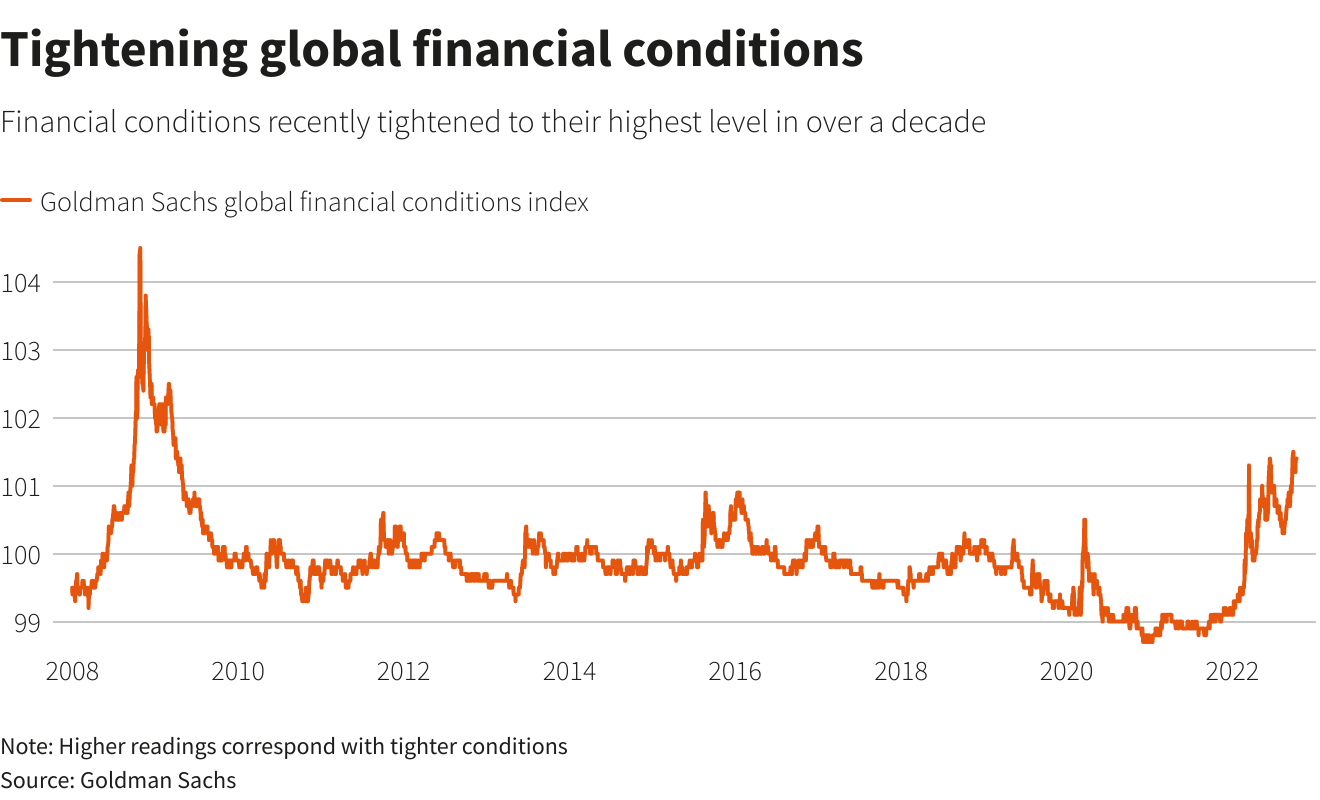
    (Reuters) – Signs of stress are growing in the global financial system, sparking worries over everything from contagion between markets to ruptures in financial products.The concerns come as central banks around the world furiously tighten monetary policy in their fight to tame inflation, creating an environment investors and policymakers say is fertile ground for episodes of financial instability. Investors got a taste of the eye-popping volatility such episodes can bring last month, when a blowout in UK debt reverberated around the world. Though the Bank of England stepped in to stabilize markets, a number of closely-watched indicators such as global demand for dollars and risk aversion in credit markets still show increasing financial stress.Meanwhile, warnings of more ructions ahead are mounting. This week alone, a gloomy report from the International Monetary Fund flagged risks of “disorderly asset repricings” and “financial market contagions” while JPMorgan (NYSE:JPM) chief Jamie Dimon predicted a looming recession. Ray Dalio, founder of Bridgewater, the world’s largest hedge fund, on Tuesday said a “perfect storm” was coming for the U.S. economy. Global financial conditions, which reflect the availability of funding, touched their tightest since 2009 in late September, an index compiled by Goldman Sachs (NYSE:GS) showed, lifted by surging interest rates, falling equities and a soaring dollar. GRAPHIC – Tightening global financial conditions Suzanne Hutchins, investment manager of global funds at Newton Investment Management, said the current environment raises the risk of so-called black swan events, or unforeseen occurrences that typically have extreme consequences.“We know the market is pretty illiquid at the moment,” she said. “There’s a huge amount of leverage in the financial system and rates are now a lot higher so there’s certainly going to be some casualties out there.” WATCHING THE DASHBOARDAmong the indicators to gauge stress in the world economy is global demand for dollars, which has soared as investors seek shelter in the U.S. currency from volatile asset markets. Three-month euro/dollar cross currency basis swap spreads, which measure demand for dollars in the currency derivatives market, this month widened to their highest level since March 2020 as volatility in UK gilts roiled asset prices. They have remained at elevated levels since late September.A similar dynamic played out in dollar/yen swap spreads, indicating non-U.S. borrowers are prepared to pay a premium for dollar funds.“The magnitude of the (moves) is quite unusual,” said Tobias Adrian, director of the IMF’s Monetary and Capital Markets Department. “There are dollar funding shortages.”The IMF’s Global Financial Stability Report, released Tuesday, also highlighted specific risks in open-end investment funds and the leveraged loan market. GRAPHIC – Dollars in demandhttps://graphics.reuters.com/GLOBAL-FOREX/DOLLAR/akvezdydzpr/chart.png Meanwhile, the corporate debt market is showing the highest levels of risk aversion in years. The yield spread on the ICE (NYSE:ICE) BofA U.S. Corporate Index, which indicates the premium investors demand to hold corporate bonds over Treasuries, rose to its highest level since June 2020 last month and has eased only marginally. GRAPHIC – Bond safety premium risinghttps://fingfx.thomsonreuters.com/gfx/mkt/mypmndwlkvr/Pasted%20image%201665583932128.png Last month’s UK-led spike in global volatility showed how easily risks can reverberate through markets when monetary policy is tightening across the world, said Ed Perks, CIO at Franklin Income Investors.“I think what it really highlights to me is that when you do tightening cycles, let alone of this magnitude … strains are felt,” he said.Of course, a systemic crisis is by no means assured. U.S. Treasury Secretary Janet Yellen on Tuesday said she has not seen signs of financial instability in U.S. financial markets despite high volatility. “We’re far away from people being in a mode where they’re saying this is a distressed scenario,” said Michel Vernier, head of fixed income strategy at Barclays (LON:BARC) Private Bank. “We have excessive inflation, but we’ve been given time to prepare on the household, corporate side and on the government side.”Still, few believe the gyrations in global markets will subside soon. Bank of England Governor Andrew Bailey threw markets another curve ball on Tuesday when he said British pension funds hit by a slump in bond prices had just three days to fix their problems before the central bank withdrew support. GRAPHIC – British bond yields soar https://graphics.reuters.com/USA-BONDS/BRITAIN/gdpzyzaoxvw/chart.png At the same time, volatility in U.S stocks and Treasuries has risen ahead of Thursday’s inflation data, corresponding to levels associated with “very stressed events,” said the IMF’s Adrian. GRAPHIC – Volatility on the risehttps://fingfx.thomsonreuters.com/gfx/mkt/egpbkzezovq/Pasted%20image%201665522236629.png Financial stability is “another type of risk that now clients are more in tune with,” Vasiliki Pachatouridi, BlackRock (NYSE:BLK)’s Head of EMEA iShares Fixed Income Strategy, told Reuters, based on recent meetings with clients. “I would say classic inflation is top of the list, then geopolitics and financial stability.” Axel Weber, chairman of the Institute of International Finance, told attendees at the group’s annual meeting Tuesday he expects more volatility as central banks rush to raise rates in the face of persistent inflation. “I haven’t seen anything like this in the last 50 years,” said Weber, who formerly served as chairman of UBS AG and president of the German Bundesbank.“The impact on markets will be more brutal, it will be more front-loaded, and it will be much more massive,” he said. More

  • in

    LatAm ministers call for finance tools to protect against climate disasters

    Ministers also urged the IDB to continue backing projects that protect the environment, with the regional lender having historically invested nearly $10 billion in this area.”We need products with incentives,” Uruguay’s finance minister Azucena Arbeleche said at meeting hosted by the IDB in Washington. “An under-developed country is not going to indebt itself to pursue this path when it has short-term emergencies.”Jamaican finance minister Nigel Clarke called for “risk transfer instruments” that would allow Caribbean countries to protect fiscal sustainability, even after natural disasters.Among the hardest hit by rising temperatures, Caribbean nations are preparing to seek compensation at the COP27 climate talks, as climate change inflicts increasingly devastating blows to its tourism industry.Though Latin America and the Caribbean are relatively minor contributors to greenhouse gas emissions, the IDB estimates that rising temperatures, sea levels and changing rainfall patterns will in 30 years cost the region some 2%-4% of annual GDP.Ten years ago, the bank estimated climate change could cost the region $100 billion annually by 2050.Ministers also discussed initiatives their countries were taking to combat economic turmoil and climate disasters.Uruguay’s Arbeleche said her government was preparing to issue a sovereign bond with interest rates linked to environmental actions.Colombia’s financial minister Jose Antonio Ocampo said he was looking at developing alternative exports and growing the country’s eco-tourism sector to diversify from oil income.”Colombia can no longer rely on oil as its main export, that’s a top priority for us,” he said. More

  • in

    Yellen warns of ‘geopolitical coercion’ by Russia, China

    WASHINGTON (Reuters) -U.S. Treasury Secretary Janet Yellen on Wednesday said the global economy was facing “significant headwinds” and the United States was working to shore up its supply chains and guard against “geopolitical coercion” by Russia, China and others.Yellen told an event hosted by the Bretton Woods Committee, a booster group, that Washington was working to deepen integration with the European Union and Indo-Pacific countries, including many emerging markets and developing countries, while building in more redundancies in its supply chains.”We know the cost of Russia’s weaponization of trade as a tool of geopolitical coercion, and we must mitigate similar vulnerabilities to countries like China,” Yellen said, underscoring Washington’s determination to hold Russia accountable for its invasion of Ukraine and its initial blockade of food and energy shipments from the country.Yellen and other Biden administration officials have also been outspoken about the need to reduce dependence on Chinese supply chains and counter what they see as Beijing’s bad behavior in the global economy.She said Washington was working to reduce U.S. companies’ “extreme dependence” on semiconductors from Taiwan and other technologies, including solar panels or critical components for electric vehicle batteries made in China and a few other countries.”Friend-shoring is not meant to be a tiny handful of countries. It’s not meant to be protectionism. It’s something that’s meant to (gain) diversity…but still get the benefits of trade,” Yellen said.U.S. Trade Representative Katherine Tai last month also raised concerns about China’s “non-market economic policies and practices and economic coercion” during a meeting with Britain’s new Secretary of State for International Trade Kemi Badenoch. More

  • in

    Billions of euros of EU funds misspent in error, fraud cases up – auditors

    In its annual report, the European Court of Auditors (ECA), which is responsible for assessing the EU budget, estimated that an average of 3% of last year’s 181.5-billion-euro spending was irregular, up from 2.7% the previous year.”The level of error for high-risk expenditure was pervasive,” auditors said in the report, issuing an “adverse opinion” on the 27-nation bloc’s spending last year.Auditors pointed out that errors were mostly caused by national authorities’ having trouble with applying complex rules and criteria for the selection of funds’ beneficiaries. That did not represent a measure of fraud or waste of funds, they said.However, they identified 15 cases of potential fraud, up from six in the previous year’s assessment.Auditors’ opinions do not lead to immediate consequences, but could spur investigations in suspect fraud and should be used by authorities to improve spending in following years. National and local authorities in the 27 EU member states are responsible for spending most of the EU money. More

  • in

    Japan Inc strongly backs defence spending, many firms near limit on weak yen – Reuters poll

    TOKYO (Reuters) – Japanese firms overwhelmingly support increasing defence spending amid heightened sabre-rattling in Asia, according to a Reuters monthly poll on Thursday, which also showed half of companies expect the yen’s decline to hurt profits.North Korea has launched seven ballistic missile tests since Sept. 25, and last month declared itself a nuclear weapons state. Meanwhile, Chinese warships have made repeated incursions into Japanese waters and concerns remain that Beijing will try to take control of democratically-governed Taiwan, which it claims as Chinese territory, by force.Amidst those threats and rising geopolitical tensions following Russia’s invasion of Ukraine, Prime Minister Fumio Kishida has pledged to “substantially” boost defence spending, which remains under his ruling party’s goal of 2% of GDP. The latest Reuters poll showed that 81% of Japanese companies were in favour of raising defence spending to that level. That should be paid for through reallocations from existing funds, 67% of firms said, the most popular answer among options that included options to raise various taxes.It was the first time the question about the size of the defence budget appeared in the Reuters poll, but the result showed a marked change from an August 2018 survey when 23% of firms said defence budgets should be cut to pay for infrastructure investment.”In these turbulent times when some authoritarian nations continue to carry out outrageous actions, there’s no doubt that we have to take action to protect ourselves,” wrote a manager at an industrial ceramics company, responding on condition of anonymity. During the time span of the latest survey, North Korea launched a ballistic missile that passed over the Japanese mainland for the first time in five years. And in last month’s poll, three quarters of firms said they were concerned about a geopolitical crisis around Taiwan.The yen’s rapid depreciation is still weighing heavily on business sentiment at companies and their wherewithal to consider wage increases that have been a key platform of Kishida’s administration. The yen has been hammered due to the growing gap between U.S. and Japanese interest rates, losing about 20% of its value against the dollar since the start of this year. The yen crossed 146 per dollar on Wednesday, past the 24-year low that prompted Japan to intervene in markets last month to boost its currency.Half of firms polled expect the weak yen to hurt profits through the end of January, compared with 29% who expected it would boost earnings.That is not much changed from a Reuters poll in April, when 48% of firms expected the yen’s drop to hurt earnings, versus 23% who expected a boost.SLUGGISH GROWTHAmong those hurt by the weak yen, 64% said they were coping by raising prices, the most common response. Diversifying sources of raw materials was cited by 28% of firms, the same percentage who said they were employing energy and labour conservation efforts.Three quarters of firms, polled before the yen hit its fresh low this week, said they could not compensate for the currency’s drop beyond the 145 mark.”Currently, we are responding by passing on the higher prices, but we’ve reached a tolerance limit for price hikes, and this could be a major factor in profit declines going forward,” said a manager at a wholesaling company.On employee wages, 61% of respondents said they were considering increases but were undecided on the level. The rest said they planned no wage hikes or increases of 5% or less.Just 23% of respondents said current business conditions were good, with 21% expecting the operating environment to be favourable through January.The Reuters Corporate Survey, conducted for Reuters by Nikkei Research, canvassed 495 big, non-financial Japanese firms on condition of anonymity, allowing them to speak more freely. More

  • in

    UK house price growth slows to weakest since July 2020 – RICS

    LONDON (Reuters) – British house prices rose last month at their slowest pace since early in the coronavirus crisis and they look on course to fall as a surge in mortgage costs adds to uncertainty about the economy for home-buyers, a survey showed on Thursday.Enquiries by new buyers fell for a fifth month in row and expectations for the year ahead suggested a slight fall in prices, according to the Royal Institution of Chartered Surveyors’ (RICS) monthly survey.The RICS house price balance – measuring the difference between the percentage of surveyors reporting price rises and those seeing a fall – fell sharply to +32 in September from +51 in August, signalling a slowdown in price growth.September’s reading was the weakest since July 2020, and a separate balance for sales volumes was the most negative since May 2020, the figures showed.”Even though the headline price balance remains in positive territory for now, storm clouds are visible in the deterioration of near-term expectations for both pricing and sales,” RICS’s chief economist Simon Rubinsohn said.”Looking further out, the picture portrayed by the RICS survey has clearly shifted in a negative direction,” he added.After booming during and after the COVID-19 lockdowns as home-owners sought bigger properties, Britain’s housing market has cooled recently.Mortgage lender Halifax has reported falling prices, in month-on-month terms, in two of the last three months. Rival lender Nationwide says British house prices failed to rise in monthly terms for the first time since July 2021 in September.The Bank of England has raised borrowing costs from 0.1% in December 2021 to 2.25% now. Investors are betting on a full percentage-point increase at the BoE’s next policy announcement on Nov. 3 as it tries to get a grip on inflation which could be pushed higher by the tax cut plans of Britain’s new government.A surge in borrowing costs in financial markets, fuelled by concerns among investors over the extra borrowing implied by the government’s plans, has pushed mortgage rates sharply higher.Rubinsohn said the mortgage market had yet to settle “but it is difficult not to envisage further pressure on the housing sector as the economy adjusts to higher interest rates and the tight labour market begins to reverse”.A recent cut to Britain’s stamp duty tax on property purchases, part of finance minister Kwasi Kwarteng’s package of tax cuts, was set to be outweighed by the rise in mortgage costs, RICS said. More