
More stories

  • in

    Pakistan default fears spike on report of UN debt suspension advice

    Devastating floods engulfed large swathes of Pakistan this month, killing more than 1,500 people and causing damage estimated at $30 billion, fanning fears that Pakistan will not meet its debts.A memorandum the United Nations Development Programme (UNDP)is set to hand Pakistan’s government this week says its creditors should consider debt relief in the wake of the floods, according to the Financial Times. The memorandum further proposed debt restructuring or swaps, in which creditors would forego some repayments in exchange for Pakistan’s agreement to invest in climate change-resilient infrastructure, the paper said.Neither the foreign office in Islamabad or a UNDP spokesperson in Pakistan immediately responded to Reuters’ request for comment on the memorandum. The country’s finance and information ministers could also not be reached.The bond market reaction on Friday strengthened fears of another default by Pakistan, hammering its international market government debt.One of the main sovereign bonds due for repayment in 2024 slumped more than 10 cents to about 50 cents on the dollar, while another due in 2027 fell to about 45 cents..Pakistan’s Finance Minister Miftah Ismail told a Reuters interview earlier this week that there was no chance of a credit default risk.The government needs to pay $1 billion on bonds maturing in December. It has interest payments worth around $0.6 billion for the 2022-23 fiscal year but the next full bond redemption is not until April 2024. DEBT RELIEFPrime Minister Shehbaz Sharif appealed on Friday to the world and rich nations for immediate debt relief, saying what had been done was commendable, but adding, “It’s far from meeting our needs.”Sharif, who along with Ismail is in New York to attend the U.N. General Assembly, told Bloomberg TV that Pakistan had taken up the debt relief issue with U.N. Secretary General Antonio Guterres and world leaders. “We have spoken to European leaders and other leaders to help us in Paris club, to get us a moratorium,” he said, referring to rich nation creditors.Sharif and finance minister Ismail said they had also taken up the relief issue with the International Monetary Fund and the World Bank. Ismail said the IMF has “almost agreed” to the request for easing the conditions of Pakistan’s $7 billion programme that was resumed in July after being delayed for months.”They’ve said almost yes,” he told local Pakistani Dunya News TV in New York a day after Sharif met the IMF’s managing director.The IMF’s representative in Islamabad didn’t respond to a request for comment. The country of 220 million would not be able to stand on its feet, Sharif added, “unless we get substantial relief”.He said Pakistan would also seek relief from long-time ally China, to which it owes about 30% of its external debt.Both Pakistan’s government and Guterres have blamed the flooding on climate change. More

  • in

    Bond sell-off worst since 1949, investor sentiment plummets – BofA

    This year’s dramatic bond tumble threatens credit events and a potential liquidation of the world’s most crowded trades, including bets on the dollar that have taken the greenback to multi-year highs against other currencies and bets on U.S. technology stocks, the bank said.Bond funds recorded outflows of $6.9 billion during the week to Wednesday, while $7.8 billion was removed from equity funds and investors plowed $30.3 billion into cash, BofA said in a research note citing EPFR data.Investor sentiment is the worst it has been since the 2008 global financial crash, the note said. U.S. markets appear set for another volatile day. Wall Street futures fell on Friday as investors fretted over the prospect of an economic downturn and a hit to corporate earnings from the U.S. Federal Reserve’s aggressive policy tightening moves to quell inflation. The S&P 500 is down nearly 5% this month and approaching its mid-June bear market lows.Treasury yields, which move inversely to bond prices, were again rising after hitting their highest level since 2011 on Thursday, with the U.S. benchmark 10-year yield recently around 3.76%.The bond crash “threatens liquidation of (the) world’s most crowded trades” including long dollar and long U.S. tech, BofA wrote.BofA said investors faced more inflation, interest rates and recession shocks, adding a bond crash meant that a high in credit spreads and low in stocks had not yet been reached.Aggressive rate hikes from major central banks to contain inflation, even as growth slows, has unnerved world markets and sparked a fresh surge in bond yields this week. More

  • in

    China central bank says to steadily and prudently push forward yuan internationalisation

    The People’s Bank of China (PBOC) also said it will also promote a virtuous circulation of onshore and offshore yuan markets, reiterating that it will “resolutely fend off systemic risks,” it said in a yuan internationalisation report published on Friday.The report comes at a time when the currency is facing renewed depreciation pressure, weighed by a buoyant dollar, hawkish Federal Reserve tightening and a slowing economy. [CNY/]China, along with Japan, is among major outliers in a global run of interest rate hikes to tame high inflation, with Beijing focused on reviving the economy hurt by COVID-19 shocks. But such widening policy divergence weighed on the yuan, and prompted overseas investors to cut holdings of Chinese bonds for a seventh consecutive month in August.The PBOC said in the report that it will facilitate overseas investors, especially global central banks and similar institutions, to increase holdings of Chinese assets.China will “improve the liquidity of yuan-denominated financial assets, further facilitate foreign investors’ access to Chinese markets for investments and enrich the variety of assets available for investments,” the central bank said. More

  • in

    Big UK tax cuts deepen selloff, dollar soars and bonds plunge

    https://fingfx.thomsonreuters.com/gfx/mkt/dwvkrxojzpm/Pasted%20image%201663930390744.png

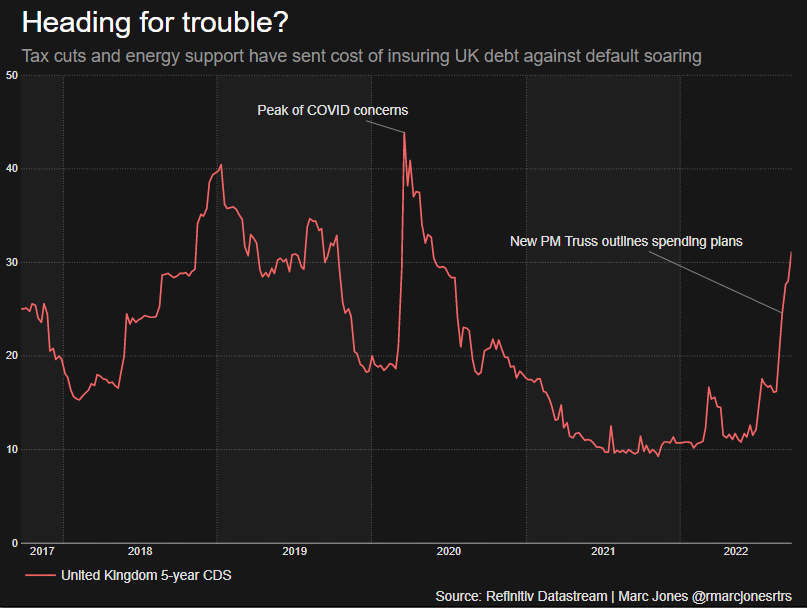
    LONDON (Reuters) – Stocks hit two-year lows on Friday, the dollar scaled a two-decade high and bonds sold off again as investors feared bigger interest rate rises are on their way to tame inflation, while UK assets plunged after huge debt-financed tax cuts were announced.UK assets were already weaker but extended their fall after Britain’s new finance minister unveiled an historic tax-cutting agenda that will see government borrowing soar. UK bond yields were set for their biggest daily rise in decades, and money markets were pricing in Bank of England interest rates of as much as 5% by May next year. Sterling lost 2%.The mood on markets has been sour all week, with major central banks delivering another 350 basis points of rate hikes to fight inflation, Japan intervening to prop up the yen and grim purchasing managers index data on Friday pointing to a deepening slowdown in major economies.Rates were hiked in the United States, Britain, Sweden, Switzerland and Norway – among other places – but it was the Federal Reserve’s signal that it expects high U.S. rates to last through 2023 that sparked the latest sell-off.MSCI’s world stocks index fell to its lowest since mid-2020 on Friday, having lost about 12% in the month or so since Fed Chair Jerome Powell made clear that bringing down inflation would hurt.The euro fell for a fourth straight day after data showed the downturn in the German economy has worsened in September, as consumers and businesses face an unprecedented energy crunch and spiralling inflation.European stocks were a sea of red for a second day, under pressure from losses in everything from bank to natural resources and technology shares. (EU)The pan-regional STOXX 600 was down about 2.2%, while Frankfurt’s DAX lost 1.94%, ranking it as one of Europe’s worst-performing indices. “Pretty much anything besides inflation data and central bank policy decisions is just noise at the moment, with the market firmly, and almost solely, focused on how high rates will rise across developed markets, and how long they will remain at those peaks,” Caxton FX chief strategist Michael Brown said.S&P emini futures fell 1.15%, suggesting a weaker start on Wall Street later.London’s FTSE lost 1.9%, against a backdrop of the pound tumbling 2% to another 37-year low and as weak as $1.1022 at one point. The cost of insuring UK debt against default also jumped. GRAPHIC – Cost of insuring UK debt against default soars “Typically looser fiscal and tighter monetary policy is a positive mix for a currency – if it can be confidently funded,” said Chris Turner, global head of markets at ING: “Here is the rub – investors have doubts about the UK’s ability to fund this package, hence the gilt under-performance.”KING DOLLARWith U.S. rates set to rise faster and stay high for longer, the dollar hit its highest in two decades and extended its double-digit gains for the year against several currencies. The Swedish crown, sensitive to the global investor mood, has this week repeatedly dropped against the dollar to its weakest since at least the early 1970s, Refinitiv data showed. GRAPHIC – King dollar reigns supremehttps://fingfx.thomsonreuters.com/gfx/mkt/lbvgnkkylpq/Pasted%20image%201663851778713.png Yields on the benchmark 10-year U.S. Treasury note have soared as investors ditch inflation-sensitive assets like bonds. The 10-year yield rose 5 basis points to 3.776%, another 11-1/2 year high and on course for its eighth consecutive weekly increase.Euro zone bond yields also rose sharply, with the Italian 10-year hitting 4.294%, its highest since late 2013, ahead of Italian elections on Sunday. The euro marked another 20-year low, plunging as far as $0.9736. The Japanese yen fell sharply on Thursday until Japanese authorities stepped in to buy the currency for the first time since 1998 and arrest its long slide.On Friday the yen gave up some of its gains, with the dollar up 0.4% at 142.97 yen per dollar. Few believe the yen rally will hold given how dovish the Bank of Japan remains.Gold, which pays no interest, has come under pressure, particularly over the course of this quarter, as yields have risen. It was last down 1.55% on the day around $1,644 an ounce, at its weakest in two years. More

  • in

    Airbus backs delivery target despite supply constraints

    Airbus has backed itself to meet its target of delivering about 700 aircraft by the end of the year but warned it would be “anything but a walk in the park” as the aviation industry continues to battle supply chain constraints. The world’s largest plane maker said on Friday that it was grappling with “multiple crises” but that issues around the supply chain were its greatest challenge. Like other global manufacturers, Airbus has struggled with shortages of raw materials, electronic components and the availability of labour, just as demand has rebounded in the wake of the coronavirus pandemic. Soaring inflation, uncertainty over the war in Ukraine and energy costs have deepened the pressures. Dominik Asam, Airbus chief financial officer, said the company had delivered 382 aircraft through to the end of August, leaving about 320 planes still to be delivered to meet the target. The company, Asam told a capital markets briefing on Friday, was “fully engaged” to deliver on its commitments, “yet against the backdrop of disruptions in global supply chains, delivering around 700 aircraft in 2022 is anything but a walk in the park”.Airbus in July cut its original year-end delivery target from 720 to “around 700” aircraft. It also adjusted the planned output of its best-selling A320 family of jets for this year and next. The company said it was targeting a monthly production rate of 65 in early 2024 — some six months later than originally forecast. Airbus at the time, however, said it was sticking with its plan to get to a monthly rate of 75 jets by 2025.Guillaume Faury, Airbus chief executive, on Friday reiterated the rate of 75 jets a month. The company expects to be producing about 50 a month by the end of this year. “Based on the visibility we have now from the supply chain we think it’s manageable, but I will not tell you that it’s easy,” Faury said of the 700-plane target. “There’s a hell of a lot of work to be done,” he added, noting that Airbus expects the crisis to persist into next year. The bottleneck in the supply of engines, however, which has been a cause of friction between Airbus and engine makers including CFM International, a joint venture between Safran and GE, is easing. The number of “gliders” — aircraft that have been built but are sitting in storage without engines — had reduced to single figures, said Faury, from 26 in July. The company has reached agreement on engine volumes with both CFM International and Pratt & Whitney for 2023 and 2024 and had started talks about numbers for 2025. More

  • in

    Rouble surges, stocks fall as Russia holds Ukraine referendums

    Despite President Vladimir Putin’s mobilisation order, the rouble hit its highest level versus the U.S. dollar and euro since July in trading in Moscow.By 1153 GMT the rouble was 3.5% stronger against the dollar at 56.79, its strongest level since July 22. Against the euro, the Russian currency had gained 4.4% to stand at 55.05 after having firmed past 55 at one point for the first time since July 4.Currency controls and month-end tax payments, which see Russia’s exporters convert their foreign currency earnings into roubles to make payments to the treasury, are providing a boost to the rouble despite geopolitical headwinds, analysts say.The increased supply of foreign currency from exporters and reports of more sanctions against Moscow from the European Union, which make foreign currency investments less attractive, were supporting the rouble, said SberCIB Investment Research in a note. “Moreover, according to data published in the media on Russia’s budget parameters, there will be no return to the budget rule and foreign currency purchases linked to this next year,” SberCIB said. “In connection with this, risks of the rouble weakening have decreased,” SberCIB analyst Yury Popov said.The finance ministry hiked taxes on oil and gas and said it would not return to its usual budget rule until 2025.The budget rule dictates how much of Russia’s revenues from oil and gas exports are used for day-to-day government spending and how much is diverted into the government’s sovereign wealth fund. Designed to smooth boom-and-bust periods, it was suspended earlier this year due to Russia’s new financial situation.However, Russian stocks were deep in the red on Friday as markets remain jittery over how Russia’s mobilisation drive will affect the conflict. The dollar-denominated RTS index dropped 0.9% to 1,163.3 points. The rouble-based MOEX Russian index was 4.1% weaker at 2,100.4 points.Russian shares have seen heightened volatility all week in response to the mobilisation order and as Moscow stages referendums in four regions of Ukraine on joining Russia.After surging in Thursday’s session on news it had enough free cash flow to pay interim dividends, shares in Gazprom (MCX:GAZP) fell back in line with the wider market on Friday, down 2.6% in rouble terms.”Today the Russian market is dominated by negative sentiment … The Friday factor seems to be stronger than usual as market players are not risking keeping their long positions over the weekend,” said Zarina Saidova, an analyst at Moscow-based Finam investment firm.For Russian equities guide seeFor Russian treasury bonds see More

  • in

    Hungary central bank seen hiking rate by 100 bps to 12.75% – Reuters poll

    BUDAPEST (Reuters) – The National Bank of Hungary is likely to raise its base rate by another 100 basis points to 12.75% next Tuesday, a Reuters poll showed, with further hikes seen by the end of the year despite the bank flagging a possible halt to its increases.The median forecast of economists shows the NBH is set to maintain the 100 bps tightening pace delivered over the past months as Hungary grapples with a jump in inflation to two-decade highs amid surging food and energy costs.Out of the 14 economists who gave forecasts, five, however, projected that the bank would slow the pace of rate hikes to 75 bps, taking the base rate to 12.5%, while one analyst pencilled in a larger 125 bps increase to 13%.Deputy Governor Barnabas Virag told reporters on Thursday that the NBH, which has raised its base rate by more than 1,100 bps since June 2021 to the highest level in central Europe, could consider ending its rate rise cycle after Tuesday’s meeting.He said the bank could raise interest rates by 50, 75 or 100 basis points, after which “all options are on the table”, including ending rate rises at once or phasing out the cycle with several smaller steps.”We narrowly favour a 75 basis point hike at the National Bank of Hungary’s September meeting, taking the base rate and the one-week depo rate to 12.50%, although 100bp remains clearly on the table,” said economist Peter Virovacz at ING.”The announcement of a prolongation of the price cap measures in basic food and fuel from the government will lower the near-term inflation peak, somewhat limiting concerns about consumer inflation expectations becoming more extreme.”Last week Prime Minister Viktor Orban’s government extended price caps on fuels and basic foodstuffs by three months until the end of the year in a bid to shield households from soaring costs.Even with the price caps in place, however, analysts polled by Reuters see headline inflation averaging 13.6% this year, rising to 13.95% in 2023 before a retreat to 4.3% by 2024.Economic growth, however, is seen slowing sharply, to just 1.3% next year from 5% expected in 2022, implying a stagflation scenario for Hungary as the energy crisis hits major European economies that absorb most of its exports.A new economic trajectory unveiled by Finance Minister Mihaly Varga earlier on Friday showed Hungary’s economy was set to contract for several quarters from the end of this year. More

  • in

    Euro zone likely entering recession as price rises hit demand -PMI

    LONDON (Reuters) – A downturn in business activity across the euro zone deepened in September, according to a survey which showed the economy was likely entering a recession as consumers rein in spending amid a cost of living crisis.Manufacturers were particularly hard hit by high energy costs after Russia’s invasion of Ukraine sent gas prices rocketing, while the bloc’s dominant services industry suffered as consumers stayed at home to save money.S&P Global (NYSE:SPGI)’s flash Composite Purchasing Managers’ Index (PMI), seen as a good gauge of overall economic health, fell to 48.2 in September from 48.9 in August, as expected by a Reuters poll.”The third decline in a row for the euro zone PMI indicates business activity has been contracting throughout the quarter. This confirms our view a recession could have already started,” said Bert Colijn at ING.A Reuters poll earlier this month gave a 60% chance of a recession in the euro zone within a year.The downturn in German business activity deepened as higher energy costs hit Europe’s largest economy and companies saw a drop in new business, data showed.However, in France activity was higher than expected although its PMI showed the euro zone’s second biggest economy was still struggling as a modest rebound in services offset a slump in the manufacturing industry.”It’s possible German GDP fell in Q3 whereas France’s economy eked out a small expansion, consistent with our view Germany will suffer more than most over the coming quarters as high energy costs weigh on energy-intensive industry as well as household budgets,” said Jack Allen-Reynolds at Capital Economics.The euro, German government bond yields and stocks all fell after the PMI data.In Britain, outside the European Union, the economy worsened as firms battled soaring costs and faltering demand, hammering home the rising risk of recession there too. In a bid to spur growth, new UK finance minister Kwasi Kwarteng on Friday was detailing close to 200 billion pounds ($223.2 billion) of tax cuts, energy subsidies and planning reforms.PRICE PRESSURESOverall demand in the euro zone fell to its lowest since November 2020, when the continent was suffering a second wave of COVID-19 infections. The new business PMI fell to 46.0 from 46.9.The euro zone services PMI fell to 48.9 from 49.8, its second month sub-50 and the lowest reading since February 2021. The Reuters poll had predicted a more modest fall to 49.0.With prices on the rise again and demand falling, optimism about the coming 12 months waned. The business expectations index fell to 53.8 from 56.6, its lowest since May 2020.Manufacturers also had a worse month than predicted. Their PMI sank to 48.5 from 49.6, compared to the 48.7 forecast in the Reuters poll and the lowest since June 2020. An index measuring output, which feeds into the composite PMI, nudged down to 46.2 from 46.5.Likely of concern to the European Central Bank, which raised its key interest rates by 75 basis points earlier in September to try and tame inflation running in August at over four times its target, the survey showed prices had risen faster this month.Both the input and output manufacturing prices indexes reversed a downward trend and rose. The input price index reached a three-month high of 76.4 from 71.7.($1 = 0.8962 pounds) More