
More stories

  • in

    What Will Happen to Black Workers’ Gains if There’s a Recession?

    Black unemployment fell quickly after the initial pandemic downturn. But as the Federal Reserve fights inflation, those gains could be eroded.Black Americans have been hired much more rapidly in the wake of the pandemic shutdowns than after previous recessions. But as the Federal Reserve tries to soften the labor market in a bid to tame inflation, economists worry that Black workers will bear the brunt of a slowdown — and that without federal aid to cushion the blow, the impact could be severe.Some 3.5 million Black workers lost or left their jobs in March and April 2020. In weeks, the unemployment rate for Black workers soared to 16.8 percent, the same as the peak after the 2008 financial crisis, while the rate for white workers topped out at 14.1 percent.Since then, the U.S. economy has experienced one of its fastest rebounds ever, one that has extended to workers of all races. The Black unemployment rate was 6 percent last month, just above the record low of late 2019. And in government data collected since the 1990s, wages for Black workers are rising at their fastest pace ever.Now policymakers at the Fed and in the White House face the challenge of fighting inflation without inducing a recession that would erode or reverse those workplace gains.Decades of research has found that workers from racial and ethnic minorities — along with those with other barriers to employment, such as disabilities, criminal records or low levels of education — are among the first laid off during a downturn and the last hired during a recovery.William Darity Jr., a Duke University professor who has studied racial gaps in employment, says the problem is that the only reliable tool the Fed uses to fight inflation — increasing interest rates — works in part by causing unemployment. Higher borrowing costs make consumers less likely to spend and employers less likely to invest, reducing pressure on prices. But that also reduces demand for workers, pushing joblessness up and wages down.“I don’t know that there’s any existing policy option that’s plausible that would not result in hurting some significant portion of the population,” Mr. Darity said. “Whether it’s inflation or it’s rising unemployment, there’s a disproportionate impact on Black workers.”In a paper published last month, Lawrence H. Summers, a former Treasury secretary and top economic adviser to Presidents Bill Clinton and Barack Obama, asserted with his co-authors that the Fed would need to allow the overall unemployment rate to rise to 5 percent or above — it is now 3.5 percent — to bring inflation under control. Since Black unemployment is typically about double that of white workers, that suggests that the rate for Black workers would approach or reach double digits.In an interview, Mr. Summers said that outcome would be regrettable and, to some extent, unavoidable.“But the alternative,” Mr. Summers argued — “simply pretending” the U.S. labor market can remain this hot — “is setting the stage for the mistakes we made in the 1970s, and ultimately for a far larger recession, to contain inflation.”The State of Jobs in the United StatesEmployment gains in July, which far surpassed expectations, show that the labor market is not slowing despite efforts by the Federal Reserve to cool the economy.July Jobs Report: U.S. employers added 528,000 jobs in the seventh month of the year. The unemployment rate was 3.5 percent, down from 3.6 percent in June.Slow Wage Growth: Pay has been rising rapidly for workers at the top and the bottom. But things haven’t been so positive for all professions — especially for pharmacists.Care Worker Shortages: A lack of child care and elder care options is forcing some women to limit their hours or has sidelined them altogether, hurting their career prospects.Downsides of a Hot Market: Students are forgoing degrees in favor of the attractive positions offered by employers desperate to hire. That could come back to haunt them.“These arguments have nothing to do with how much you care about unemployment, or how much you care about the unemployment of disadvantaged groups,” he continued. “They only have to do with technical judgment.”Many progressive economists have been sharply critical of that view, arguing that Black workers should not be the collateral damage in a war on inflation. William Spriggs, an economist at Howard University, cautioned against overstating the Fed’s ability to bring inflation under control — especially when inflation is being driven in part by global forces — and underestimating the potential damage from driving interest rates much higher.Black workers will suffer first under a Fed-induced recession, Mr. Spriggs said. When that happens, he added, job losses across the board tend to follow. “And so you pay attention, because that’s the canary in the coal mine,” he said.In a June 2020 essay in The Washington Post and an accompanying research paper, Jared Bernstein — now a top economic adviser to President Biden — laid out the increasingly popular argument that in light of this, the Fed “should consider targeting not the overall unemployment rate, but the Black rate.”Fed policy, he added, implicitly treats 4 percent unemployment as a long-term goal, but “because Black unemployment is two times the overall rate, targeting 4 percent for the overall economy means targeting 8 percent for blacks.”The Fed didn’t take Mr. Bernstein’s advice. But in the years leading up to the pandemic, Fed policymakers increasingly talked about the benefits of a strong labor market for racial and ethnic minorities, and cited it as a factor in their policy decisions.After Mr. Biden took office, he and his economic advisers pushed for a large government spending bill — which became the $1.9 trillion American Recovery Plan — in part on the grounds that it would avoid the painful slog that job seekers, particularly nonwhite workers, faced after the 2007-9 recession and would instead deliver a supercharged recovery.Federal pandemic relief provided a cushion for Ms. Jordan, at her home near Atlanta with her husband and children. Rita Harper for The New York Times“It’s been faster, more robust for African Americans than any other post-recessionary periods since at least the 1970s,” Cecilia Rouse, the chair of Mr. Biden’s Council of Economic Advisers, said in an interview. Black workers are receiving faster wage gains than other racial and ethnic groups, and have taken advantage of the strong job market to move into higher-paying industries and occupations, according to an analysis of government data by White House economists shared with The New York Times.Menyuan Jordan is among them. Ms. Jordan, who has a master’s degree in social work and was making a living training child care providers in February 2020, saw her livelihood upended when Covid-19 struck.“The money was based off face-to-face professional development that went to zero almost immediately overnight,” she said. “I couldn’t afford the rent.”But pandemic relief packages from the federal government helped cushion the blow of lost earnings. And by last winter, Ms. Jordan had landed a job as a mental health clinician near her home in Atlanta — one that offered training and paid roughly $13,000 more than her prepandemic role, which she estimates brought in $42,000 annually.Administration officials say they are optimistic that Black workers can continue to see higher wages and improving job opportunities even if the labor market cools. But Goldman Sachs analysts, echoing a common view, recently concluded that average wage gains for workers would need to fall much further to be consistent with the Fed’s inflation goals.Fed policymakers are still somewhat hopeful that they can bring down inflation without causing a recession or undoing the gains of the past two years, in part because of a hope that the labor market can slow down mainly through reductions in job openings rather than layoffs.Jerome H. Powell, the Fed chair, has made the case that only by bringing inflation under control can the central bank create a sustainably strong labor market that will benefit all workers.“We all want to get back to the kind of labor market we had before the pandemic,” Mr. Powell said in a news conference last month. “That’s not going to happen without restoring price stability.”Some voices in finance are calling for smaller and fewer rate increases, worried that the Fed is underestimating the ultimate impact of its actions to date. David Kelly, the chief global strategist for J.P. Morgan Asset Management, believes that inflation is set to fall considerably anyway — and that the central bank should exhibit greater patience, as remnants of pandemic government stimulus begin to vanish and household savings further dwindle.“The economy is basically treading water right now,” Mr. Kelly said, adding that officials “don’t need to put us into a recession just to show how tough they are on inflation.”Michelle Holder, a labor economist at John Jay College of Criminal Justice, similarly warned against the “statistical fatalism” that halting labor gains is the only way forward. Still, she said, she’s fully aware that under current policy, trade-offs between inflation and job creation are likely to endure, disproportionately hurting Black workers. Interest rate increases, she said, are the Fed’s primary tool — its hammer — and “a hammer sees everything as a nail.”Reflecting on a dinner she recently attended in Washington with “really high-level, all-white progressive economists,” Ms. Holder, who is Black, said there was a “resigned attitude” among many of her peers, who want positive near-term outcomes for people of color overall but remain “wedded to the use of mainstream tools” and ask, “What else can we do?”Mr. Darity, the Duke professor, argued that one solution would be policies that helped insulate workers from an economic downturn, like having the federal government guarantee a job to anyone who wants one. Some economists support less ambitious policies, such as expanded benefits to help people who lose jobs in a recession. But there is little prospect that Congress would adopt either approach, or come to the rescue again with large relief checks — especially given criticism from many Republicans, and some high-profile Democrats, that excessive aid in the pandemic contributed to inflation today.“The tragedy will be that our administration won’t be able to help the families or individuals that need it if another recession happens,” Ms. Holder said.Morgani Brown, 24, lives and works in Charlotte, N.C., and has experienced the modest yet meaningful improvements in job quality that many Black workers have since the initial pandemic recession. She left an aircraft cleaning job with Jetstream Ground Services at Charlotte Douglas International Airport last year because the $10-an-hour pay was underwhelming. But six months ago, the work had become more attractive.Morgani Brown returned to an employer she had left in Charlotte, N.C., when the hourly pay rose. Damola Akintunde for The New York Times“I’d seen that they were paying more, at $14,” she said, “so I went and applied for Jetstream again.” She remains frustrated with some work conditions, but said the situation had “ended up being better.”With rents rising, she saves money rooming with her boyfriend and another friend, both of whom work at an Amazon fulfillment center. Ms. Brown, who has a baby on the way, is aware that the e-commerce giant has recently cut back its work force. (An Amazon official noted on a recent earnings call that the company had “quickly transitioned from being understaffed to being overstaffed.”)Ms. Brown said she and her roommates hoped that their jobs could weather any downturn. But she has begun hearing more rumblings about people she knows being fired or laid off.“I’m not sure exactly why,” she said. More

  • in

    Bangladesh is being ‘killed by economic conditions elsewhere in the world’

    Mohammad Sharif Sarker’s factory is in many ways a model. Spread over three spacious floors in Ashulia, a suburb of Bangladesh’s capital Dhaka, hundreds of young women and men sit in orderly assembly lines, sewing machines before them, ready to stitch trendy flat-brim caps for export.There’s only one problem: Sarker and his workers are sitting in the dark, their machines idle. Ashulia is currently in the middle of one of the daily mandatory power cuts that the government introduced in July, as Bangladesh grapples with a severe energy crunch. And with a recent government-mandated 50 per cent increase in fuel prices, Sarker has opted to keep the power off while his workers take a lunch break, rather than fire up an expensive diesel-powered generator. “The sector will be unsettled if the price of everything keeps going up,” Sarker says. “It is the workers who will ultimately carry the burden.”Factories like his have helped propel Bangladesh, previously one of the world’s poorest countries, to become the third-largest garment exporter after China and Vietnam according to World Trade Organization data — notching up significant gains in income, education and health along the way. In South Asia, a region of almost 2bn people across India, Pakistan and Sri Lanka, Bangladesh stood out for its development and success in fostering a globally competitive goods export sector. Bangladesh, previously one of the world’s poorest countries, has become the third-largest garment exporter © Mustasinur Rahman Alvi/ZUMA/ShutterstockBut now, along with most of its south Asian neighbours, the country of 160mn people is being rocked by soaring prices of energy and food following the Covid-19 pandemic and Russia’s invasion of Ukraine. These have led to energy shortages and rising import bills that are, in some cases, straining their ability to keep up with debt payments. The regional economic crisis in south Asia has been swingeing in its casualties, claiming countries whose governments pursued reckless spending policies, such as Sri Lanka, alongside model development economies. It now threatens to reverse hard-won, generational gains made in the world’s most populous emerging market region, which sits at the geopolitical junction where Indian and Chinese interests meet. Beijing is among the leading creditors of both Sri Lanka and Pakistan — and India, which is wary of China’s influence on its smaller neighbours, is watching for signs that the crisis might allow it to strengthen its hand.“The crisis is punishing countries with an array of different economic performances and models,” says Mark Malloch Brown, a former UN and World Bank official who now heads the George Soros-backed Open Society Foundations. “Bangladesh, a very internationally oriented economy known for its garment sector, is getting killed by economic conditions elsewhere in the world.”Better insulatedSri Lanka in May became the first Asia-Pacific country to default in two decades, with the economic mismanagement of President Gotabaya Rajapaksa triggering mass street protests in Colombo that forced him to flee the country on a military jet in July. Pakistan, where authorities have charged former leader Imran Khan on terrorism offences, also appears to be entering a period of enhanced political volatility, even as it seeks to nail down financing from the IMF and bilateral creditors that would allow it to avert default. Smaller Nepal and the Maldives are also vulnerable to the fallout from global inflation.

    You are seeing a snapshot of an interactive graphic. This is most likely due to being offline or JavaScript being disabled in your browser.

    Bangladesh had until recently been better insulated from recent economic shocks, in part because of its successful export sector. But Prime Minister Sheikh Hasina’s government in July approached the IMF for a loan to try and shore up its foreign currency reserves and help the low-lying country build resilience against climate change. Bangladesh is seeking about $4.5bn from the fund, and as much as $4bn more from other lenders, including the World Bank and Asian Development Bank. In addition to raising fuel prices, which triggered protests, Bangladesh’s government has cut school and office hours to conserve energy and introduced import restrictions on luxury goods to protect its foreign reserves. South Asian countries share much in common with other emerging markets from Ghana and Ethiopia to Chile, where long-festering problems have been brought to a head in a year of the most acute sovereign debt crises seen since the 1980s. Many South Asian countries are heavily dependent on imports of energy resources, such as crude oil and coal and foodstuffs, including cooking oil. Bangladesh, for example, was forced to shut its diesel power plants in July due to import shortages. Some of these countries also owe money to China for projects pursued under Beijing’s Belt and Road Initiative, adding a layer of geopolitical risk to any coming debt workouts for regional economies in peril. AHM Mustafa Kamal, Bangladesh’s finance minister, insists that while “everybody is under pressure”, Bangladesh is not in danger of falling into the deep financial distress of its neighbours. “Bangladesh is in no way connected” to what is happening in countries like Sri Lanka, he says. Creditors “know our projects, know our balance sheet very well. [Bangladesh] is a good place to offer money”. He highlighted the inauguration in June of the $3.6bn Padma Bridge, a Chinese-built but domestically financed project near Dhaka that will drastically cut travel times for people and goods.A protest against prices of fuel oil, urea fertiliser, foodstuff and daily commodities and transport fares in Dhaka in August © Abu Sufian Jewel/ZUMA/ShutterstockThe IMF says that with a debt-to-GDP ratio of 39 per cent — lower than its neighbours — Bangladesh is “not in a crisis situation”, but warns the country is vulnerable to the “huge uncertainty surrounding global economic developments”. Yet the regional economic ructions have caused concern in India, which has itself steered clear of crisis but, as of late July, had committed $3.8bn of aid to its bankrupt neighbour, Sri Lanka, in loans and other assistance. Malloch Brown says the experience of South Asian countries shows how the pressures on emerging markets are part of a wider “systemic crisis which really endangers the global economy”. He has called for an international policy response akin to the Marshall Plan extended to war-ruined countries after the second world war. These strains are now resonating across the global south.Rashed al Mahmud Titumir, an economics professor at Dhaka University, argues that the international community should step in to protect the hard-won gains of Bangladeshi workers. “You see the working class has a kind of resilience,” he says. “The west and the [lending] institutions should really look at that . . . it should not be allowed to free fall.”Oil drums in a warehouse in Narayanganj, Bangladesh. In addition to raising fuel prices, the government has cut school and office hours to conserve energy © Joy Saha/ZUMA/ShutterstockBoom time Following the end of British colonial rule on the Indian subcontinent in 1947, Bangladesh became a province of Pakistan, before gaining independence in 1971 after a devastating civil war that left the new country stricken by famine.The economy made significant strides in the decades that followed. Low-skilled manufacturing took off, helped by tax breaks and duty-free access to wealthy markets, creating mass employment for women as well as men. Overseas remittances also provided much-needed capital.Poverty halved from 58.8 per cent in 1991 to 24.3 per cent in 2016, while education and health indicators such as literacy and infant mortality also improved. Bangladesh’s per-capita income of $2,500 is now higher than that of both India and Pakistan. The UN plans to reclassify Bangladesh from “least developed country” to developing-country status by 2026.“Bangladesh was nowhere, not [even] on the map, as an economy,” Kamal says. That has changed “through our hard work”.Since the 1980s, Bangladesh’s garment industry has grown from 4 per cent to 80 per cent of the country’s exports, which total more than $50bn, according to the country’s garments exporters association. Most employees are women. “This sector has addressed the unemployment problem a lot,” says Sarker, himself a former assembly-line worker. “Before there were child marriages; now girls have jobs.”Yet this growth has been blighted by labour exploitation and dangerous working conditions, including the collapse of the Rana Plaza factory building in 2013 that killed more than 1,000 people. Sarwer Hossain, a union leader in Ashulia, says that working conditions have since improved but more progress is needed, with injuries and deadly accidents continuing. The minimum wage of 8,000 taka ($84) a month has also not increased since 2018, he adds. This has left workers vulnerable to inflation, which stood at 7.5 per cent year-on-year in July.Like many workers in Sarker’s cap factory, 18-year-old Rezwana Akhtar left the rural poverty of her village a year ago for a job in the city. While many of her school friends are now married and outside the workforce, even the minimum wage helps give workers like Akhtar an income and independence. But it remains a difficult life — her anxiety compounded by the recent inflation in her rent.“In the villages, we did not have jobs,” she says. “But life is harder here in the city. In the village I could go to school and I had food to eat. Here, everything is expensive.”

    You are seeing a snapshot of an interactive graphic. This is most likely due to being offline or JavaScript being disabled in your browser.

    Her story underscores not only how marginal the gains from this global industry are, but how easily they can be swept away. The garments sector helped shield Bangladesh during the pandemic, with exports rising to a record as locked-down consumers overseas shopped for clothes online. But it is now starting to feel the strain. The IMF warns that demand for Bangladesh’s cornerstone industry’s products will suffer due to slowing growth in major buyers in the US and European countries. “This is definitely going to affect export performance going forward,” the fund says. The country’s garment makers import everything from raw materials to machinery. David Hasanat, chair of Dhaka-based manufacturer Viyellatex Groups, says the price of cotton had increased more than 50 per cent, but that his company was only able to pass on about 10 per cent of that cost to buyers. “Eventually [the higher costs] will give us more pain,” he says.The rising import bill has taken a toll on Bangladesh’s foreign reserves, which have fallen to less than $40bn, from more than $45bn last year. While this remains enough for about five months’ worth of imports, Dhaka university’s Titumir says he expects it to fall below three months’ import cover — the level economists often consider critical — by the end of the year. He argues that the situation is laying bare “cracks in the economy”, from Bangladesh’s slowing poverty reduction to its stagnating wages and rising debt. He argues that this has “exposed the [success] story that we hear as a kind of a mirage”. ‘Taking flight from riskier assets’ Steve Cochrane, chief Asia-Pacific economist for Moody’s Analytics, argues that because South Asian countries did not suffer as much as other regions during the 1997-98 Asian financial crisis, they were not compelled to undertake the economic reforms that would have insulated them from the worst of this year’s crisis.Unlike Bangladesh, Sri Lanka and Pakistan “have never really been forced to try to improve economic policymaking”, he says. “Rather, they are engaged in seemingly endless rounds of negotiations with the IMF, with individual creditors and with internal constituencies, that never seem to come to an end and seldom result in permanent policy changes.” Kalabogi village in Khulna. Bangladesh had until recently been better insulated from recent economic shocks, in part because of its successful export sector © Sultan Mahmud Mukut/SOPA/ShutterstockSri Lanka, in particular, was storing up problems long before the pandemic, enacting sharp tax cuts in 2019 while borrowing heavily from bondholders and countries like China for infrastructure projects that failed to generate returns. Pakistan also struggled with a low tax base and a chronically weak export sector. “What makes Pakistan and Sri Lanka stand out is that a lot of their borrowing was done in foreign currency — this is what underpinned the issues that are coming to a head now,” says Shilan Shah, senior economist with Capital Economics. “Then the impact of the war in Ukraine caused investors globally to take flight from riskier assets.”

    India, with its better economic management, strong services sector and lower debt-to-GDP ratio, has remained insulated from direct spillover from its neighbours’ financial distress. However, officials in New Delhi are worried the crisis might allow Beijing to flex its regional leverage.“Sri Lanka is deemed geopolitically pretty important, given Chinese investment into Sri Lanka and the default on the port [of Hambantota], which was taken over by China,” Shah says. “That is a huge concern for India.”While talks with Dhaka on a lending facility remain nascent, IMF staff will travel to Sri Lanka this week to continue talks on a bailout with Ranil Wickremesinghe, the new president. The IMF also reached a preliminary agreement with Pakistan in July to lend $1.2bn as part of an existing $7bn assistance package, but it remains subject to approval by the Washington lender’s executive board, which is due to meet on August 29. In Ashulia, Akhtar and the other young workers worry about how they’re going to continue paying for rent and food on top of supporting families in their villages. “How much more do we need to earn to keep paying?” she asks.“All [workers’] dreams involve money,” says Hossain, the union leader. “But they don’t have alternatives other than working here. What they want is to save enough money to have a house and a good life.” More

  • in

    Dollar pauses for breath ahead of Jackson Hole

    SINGAPORE (Reuters) – The U.S. dollar steadied just below recent peaks on Wednesday, as investors waited to hear from the Federal Reserve and pondered whether weak U.S. data may slow the pace of rate hikes.Disappointing U.S. services and manufacturing surveys released overnight and a plunge in new home sales last month knocked the greenback from a 20-year high on the euro, though not particularly hard as growth concerns are deeper in Europe.The euro briefly bought $1 in New York trade, but by the Asia morning it was under pressure at $0.9958 – barely above Tuesday’s low of $0.99005. The yen also gave back some overnight gains to hover around 136.85 per dollar.The U.S. S&P Global (NYSE:SPGI) flash composite PMI for August dropped to 45 – the lowest since May 2020 and in contractionary territory for a second straight month, while new home sales hit a 6-1/2 year low.Sterling found some support overnight after Britain’s composite Purchasing Managers Index number managed to stay in growth territory, though it hasn’t really pierced investors’ gloom over British or Europe’s outlook.The pound is at $1.1817 after hitting a 2-1/2 year low of $1.1718 on Tuesday.”It really is just a matter of time before the hard data reflects the reality of the brutal energy price rises confronting U.K. households,” said Ray Attrill, head of FX strategy at National Australia Bank (OTC:NABZY).The Australian and New Zealand dollars bounced overnight but started to give back gains in Asia trade. The Aussie fell 0.2% to $0.6912, while the kiwi was down 0.3% to $0.6192.All eyes now turn to Jackson Hole, Wyoming, where the Federal Reserve holds its annual symposium and Fed Chair Jerome Powell is due to speak on Friday.The U.S. dollar index, which measures the dollar against a basket of currencies, rose 0.1% to 108.70 on Wednesday, and July’s two-decade high of 109.29 beckons.”The Jackson Hole symposium is not really going to give us a huge amount of reasons to want to sell dollars,” said Chris Weston, head of research at Pepperstone in Melbourne.”I think Powell might keep his foot down, and that continues to make us want to buy dollars. Any kind of pullback in the dollar remains a buying opportunity.” Minneapolis Fed Bank President Neel Kashkari repeated the need for more aggressive rate hikes to control inflation in a speech on Tuesday. More

  • in

    China's jobless turn to car boot sales as COVID-hit economy stalls

    BEIJING (Reuters) – When the COVID-19 pandemic forced Wang Wei to shut his tourism company, the Tianjin native poured his life-savings of 80,000 yuan ($11,785) into selling coffee from the back of his green Suzuki micro van in the Chinese capital Beijing.Since June, Wang has driven his mobile coffee booth from car boot fair to car boot fair, offering hand-brewed coffee steeped in an assortment of liqueurs. Once considered too low-status for many, peddling wares on the street has made a comeback as people who lost their jobs or closed down their businesses seek new ways to make a living and work around China’s relentless anti-COVID policies. Hospitality, tourism and after-school tutoring have been particularly hard hit.Wang, 40, gave up a bricks-and-mortar coffee shop in Tianjin in 2020 when the pandemic first hit. Overseas group tours he used to organise also took a blow that year, with a lucrative trip to see the aurora borealis cancelled, costing him hundreds of thousands of yuan in lost earnings.This year, the spread of the Omicron variant across China was the final nail in the coffin, making his group tours to the Chinese backcountry impossible.Wang started running his mobile coffee booth this summer, after car boot fairs emerged in big southern cities like Chengdu, Chongqing and Guangzhou.Under a canopy extending from Wang’s van, customers relax in camping chairs, with soft lights in the evening completing the glamping experience. “The rising popularity of this car boot sale market has helped me tide over the most difficult of times,” said Wang, who reckons he earns about 1,000 yuan a day. JOBLESS YOUTHChina’s economy barely grew in April-June. Youth unemployment has remained high, reaching a record 19.9% in July, the fourth month in which the rate had broken records.Pan, 25, closed his bar in Shenzhen after a COVID outbreak in March, saddling him with over 100,000 yuan in debts.”I was pretty down, and one night, my fiancée Annie, wanting to cheer me up, took me to a watering hole in a quiet area with warm, faint lights and soft music,” he said. That was when he saw a couple selling liquor at an outdoor stall, inspiring him to do the same – but from his Tesla (NASDAQ:TSLA). “My best friend lent me 3,000 yuan, which became the initial investment for our pop-up liquor shop,” Pan said.Pan and Annie ran out of money in their first week, but their determination paid off, with daily revenues since climbing as high as 7,800 yuan. “In the future, we plan to travel the country with our Tesla and sell liquor from the boot of our car in cities we enjoy the most,” said Pan. ‘PENNILESS’Policymakers, in tacit admittance jobs are harder to come by, have encouraged “flexible” employment in the informal economy. Even Beijing, which has long regarded makeshift market-places as beneath the capital, is closing an eye to car boot sales. Liu, 30, used to make a living teaching Beijing kids how to solve the Rubik’s Cube, but after in person learning was shuttered due to COVID-19, she became “penniless”. She now sells coffee from the back of her small van and hopes her small business will pull her out of her financial straits.”We are still losing money at this stage, I get less than 100 yuan a day most of the time – not enough for meals and transportation,” she said. “But I’m happy just being occupied.”($1 = 6.7879 Chinese yuan renminbi) More

  • in

    Dollar Curbs Losses After Fed’s Kashkari Flags “Even More Hawkish” Stance

    Investing.com– The U.S. dollar trimmed recent losses against a basket of currencies on Wednesday, after Minneapolis Federal Reserve Head Neel Kashkari said the central bank would keep tightening policy until it saw clear signs of easing inflation.Kashkari, who has become one of the Fed’s most hawkish members in recent months, said the bank’s biggest priority at the moment was curtailing inflation, and that it would ease on tightening only if it saw “compelling evidence” that inflation was nearing its 2% target. The dollar index arrested recent losses after his comments, and rose 0.1% to 108.69. The greenback had slipped 0.4% on Tuesday after dismal service sector data. Dollar index futures rose nearly 0.2%. Growing expectations of a hawkish Fed saw the greenback come close to a two-decade high this week. Speaking at the Wharton Minnesota Alumni Club, Kashkari expressed concerns over the possibility that the Fed has misread inflation dynamics, which could spur far more policy tightening than seen so far this year. “My biggest source of concern is that if we and financial markets are currently misreading the current inflation dynamics, then it’s going to take us a while to figure that out, and we’re going to have to be even more hawkish than I’m envisioning now,” Kashkari said. He expects the central bank to hike rates by at least 200 basis points (bps) by the end of next year. The Fed’s target rate is currently at 2.25% to 2.50%, with a majority of traders expecting a 75 bps hike in September. Kashkari’s comments come as several other officials also echoed the sentiment that inflation is still far from under control, and that several more sharp interest rate hikes are warranted to bring it under control.U.S. CPI inflation stood at an annual rate of 8.5% in July. While the reading did ease slightly from the prior month, it is still around its highest levels in 40 years.  More

  • in

    U.S. IRS launches security review after threats, misinformation on social media

    WASHINGTON (Reuters) – The U.S. Internal Revenue Service is reviewing safety and security measures in response to an “abundance” of threats and misinformation on social media about the agency and its employees, IRS Commissioner Charles Rettig said in a staff memo released on Tuesday.Rettig said the steps include new risk assessments, monitoring perimeter security at facilities, designating restricted areas and reassessing exterior lighting and entrance security. The actions follow “an abundance of misinformation and false social media postings, some of them with threats directed at the IRS and its employees,” he said.The misinformation and threats have been prompted by President Joe Biden’s new tax, climate and drugs package that provides IRS with $80 billion in new funding over a decade to beef up enforcement. They follow an armed man’s attack on an FBI office in Cincinnati and other threats in the wake of the FBI’s search of former president Donald Trump’s Florida home for documents earlier this month.Republicans are continuing to claim that the IRS is building an “army” of 87,000 “agents.” While revenue agents will be increased, the bulk of the agency’s decade-long gross hiring goal will be aimed at replacing over 50,000 retirees, improving customer service and upgrading the agency’s 1960s-era technology. Ronny Jackson, Trump’s White House physician who is now the Republican candidate for a Texas congressional seat, tweeted on Tuesday: “The IRS is recruiting an army of 87,000 SPECIAL AGENTS trained to use ‘DEADLY FORCE’. And trust me, they won’t be going after the billionaires. They will shakedown middle-class Americans for EVERY cent they have!”Rettig, a former Beverly Hills, California, tax attorney who was appointed to head the IRS by Trump and retained by Biden, did not identify specific threats to the agency or staff.But in his email sent to the IRS’s current 78,600 employees, Rettig asked them to increase their safety awareness and added, “if you see something, say something.””For me this is personal,” Rettig wrote. “I’ll continue to make every effort to dispel any lingering misperceptions about our work. And I will continue to advocate for your safety in every venue where I have an audience.” More

  • in

    How the Ukraine-Russia war rattled global financial markets

    https://graphics.reuters.com/UKRAINECRISIS-SIXMONTHS/egvbkdgeapq/chart.png

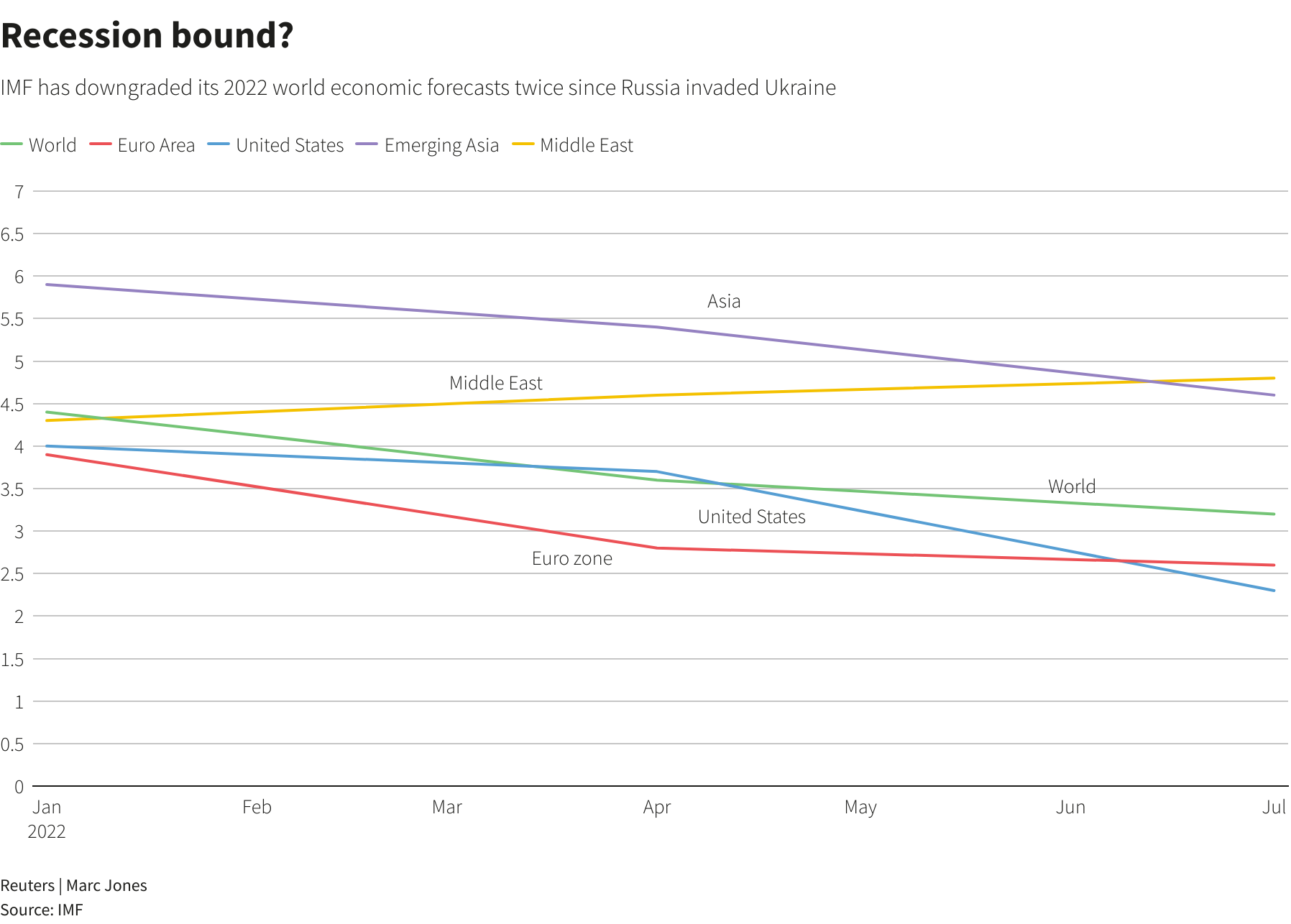
    LONDON (Reuters) – Over six months since Russia invaded Ukraine in what Moscow calls its “special military operation” thousands have been killed, millions made homeless and the world has seen the worst East-West tensions since the Cold War.It has also thrown global financial markets into severe turmoil as the charts below show.1/RECESSION FEARSRecessions now look almost certain in Europe as prices of gas, critical for households and industry, more than trebled since June alone on fears Russia will cut off its supplies, possibly leading to energy rationing in some economies. Yet the European Central Bank, the Bank of England and other central banks are determined to crush the inflation spiralling energy costs are fuelling, even if higher interest rates are bound to further squeeze households and companies struggling with rising costs. GRAPHIC – Recession bound? 2/GROWING PAINSAgricultural markets whipsawed after the invasion but have proved remarkably flexible since. Wheat and corn – Ukraine and Russia’s key exports – have swooped right back down after an initial price surge, while Moscow’s main source of income, oil, is now fetching less than when the invasion started. GRAPHIC – Six months of the Ukraine warhttps://fingfx.thomsonreuters.com/gfx/mkt/mypmneyobvr/Pasted%20image%201660815413565.png 3/INFLATION PALPITATIONSThe surge in energy and food prices, in combination with post-pandemic supply chain strains, have driven inflation rates around the world to levels last seen in the 1970s. This has had widespread ramifications for bond markets especially where borrowing costs have ballooned and default worries deepened. GRAPHIC – Inflation palpitationshttps://fingfx.thomsonreuters.com/gfx/mkt/lgvdwybdwpo/Pasted%20image%201661272612465.png 4/EURO TRASHEDThe euro is down more than 12% so far this year, more than over any comparable period in the years since its introduction in 1999, reflecting the view that further cuts in supplies of Russian gas will hit particularly hard major euro zone economies that depend on it, such as Germany and Italy. GRAPHIC – Euro trashedhttps://fingfx.thomsonreuters.com/gfx/mkt/mypmnerqqvr/Pasted%20image%201661248285941.png 5/OUT OF GAS Russian gas flows through major pipelines to Europe have fallen around 75% since the start of the year leading to accusations by top European politicians that Moscow is weaponising its natural resources.Russia has denied the cuts are premeditated, but the fact they are happening and that the EU relied on Russia for 40% of its gas before the invasion, has propelled its price to 270 euros/MWh from under 50 euros/MWh this time last year. GRAPHIC – Russia pipeline gas supplies to Europehttps://graphics.reuters.com/UKRAINE-CRSIS/RUSSIA/movangrozpa/chart.png GRAPHIC – UK gas price futureshttps://fingfx.thomsonreuters.com/gfx/mkt/znpnergmavl/Pasted%20image%201661255390184.png 6/UNDERPERFORMERS Germany’s and Italy’s reliance on Russia made their stock markets among the world’s worst performers. Those close to the fighting, including Poland and Hungary, also saw their equities and currencies pummelled. Bonds of countries with high gas or wheat import bills, took a beating too. GRAPHIC – CEE currencies crushed by crisishttps://fingfx.thomsonreuters.com/gfx/mkt/dwpkrwmwevm/Pasted%20image%201661269761912.png Graphic – German, Italian and CEE indexes underperformhttps://fingfx.thomsonreuters.com/gfx/mkt/byvrjydzqve/Pasted%20image%201661177882724.png 7/CHEMICALS AND CAR PARTSShares of chemical companies have suffered some of the biggest declines since the invasion, since natural gas plays a key role in their manufacturing process. Car parts makers have also been hit hard, partly because Russia was a major market for firms such as VW and Mercedes and partly because Ukraine and Russia have also been suppliers.”European Chemical companies have had a bit of a torrid time,” said Mirabaud equity analyst William Mileham. “There have been production stoppages, and discussions around potential gas rationing have hit their share prices hard recently.” GRAPHIC – Chemicals and car parts makers hammered by Russia Ukraine warhttps://fingfx.thomsonreuters.com/gfx/mkt/lbpgnaxxgvq/Pasted%20image%201661262372473.png 8/VOLATILE TIMESVolatility gauges for markets from stocks and bonds to oil and the euro-dollar exchange rate soared in the wake of the Feb. 24 invasion before a bumpy ride down later on. But they spiked again this month as the energy and recession worries have mounted again. Graphic – Volatility gauges erupthttps://fingfx.thomsonreuters.com/gfx/mkt/zgvomgdxgvd/Pasted%20image%201661266750960.png 9/FALLING RATINGSThe war has been mentioned as a factor in nearly 250 S&P Global (NYSE:SPGI) credit rating downgrades or outlook cuts since late February. Russian borrowers accounted for over half of them, but rising energy and borrowing costs mean the impact will continue to spread wider.Ukraine has defaulted as the war has wrecked its economy and finances. Sanctions have also pushed Russia into its first sovereign debt default in decades and left over $25 billion of the country’s corporate debt unpaid.”Russian corporates have shown a very strong willingness to keep paying foreign creditors, even with the obstacles that sanctions have placed upon them,” Jeff Grills at Aegon (NYSE:AEG) Asset Management added, though. GRAPHIC – Credit rating moves linked to Russia-Ukraine war fallouthttps://fingfx.thomsonreuters.com/gfx/mkt/zgpomgddqpd/Pasted%20image%201661263507575.png 10/CORPORATE EXODUSBig brands from Nike (NYSE:NKE) and Coca-Cola (NYSE:KO) to IKEA and Apple (NASDAQ:AAPL) are among over 1,000 global firms that have exited Russia or made public plans to scale back their activities there, according to a list https://som.yale.edu/story/2022/over-1000-companies-have-curtailed-operations-russia-some-remain?company=shell&country= compiled by researchers at Yale.It adds up to billions of dollars worth of assets. But others have either stayed or maintained https://moralratingagency.org what they have described as essential or unsellable parts of their businesses in Russia.”We have never seen anything of this magnitude in economic history,” said Jeffrey Sonnenfeld, Senior Associate Dean for Leadership Studies at Yale, who has led the project. GRAPHIC – Companies pulling out of Russiahttps://fingfx.thomsonreuters.com/gfx/mkt/zdpxozebgvx/Pasted%20image%201661265033239.png More

  • in

    Fed's Kashkari says his biggest fear is inflation will be more persistent

    Kashkari is already the most hawkish of all the central bank’s 19 policymakers and expects the Fed to need to lift its policy rate, now at 2.25%-2.5%, another two full percentage points by the end of next year.”The big fear that I have in the back of my mind is, if we are wrong and markets are wrong and that this inflation is much more embedded at a much higher level than we appreciate or markets appreciate, then we are going to have to be more aggressive than I anticipate, probably for longer, to bring inflation back down,” Kashkari said.Right now, he said, it’s “very clear” the Fed needs to tighten monetary policy.If inflation were at 4%, he said, the Fed could afford to go slow on rate hikes to make sure it doesn’t overdo it and send the economy into a downturn.But with inflation as high as it is, he said the Fed needed “to err on making sure we are getting inflation and only relax when we see compelling evidence that inflation is well on its way back down to 2%.”Kashkari says his biggest concern is that if the Fed is “misreading the underlying inflation dynamics, then it’s going to take us a while probably to figure that out, and then we are going to have to be even more hawkish than I am envisioning right now.” More